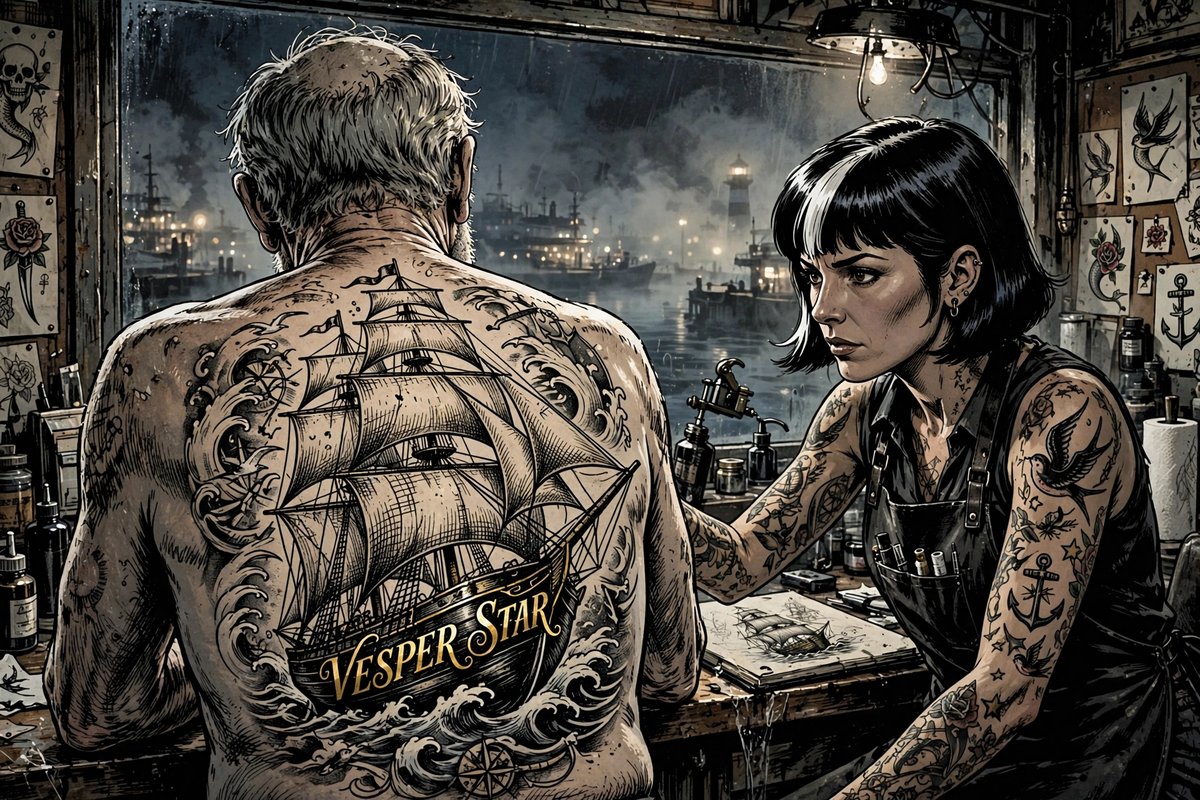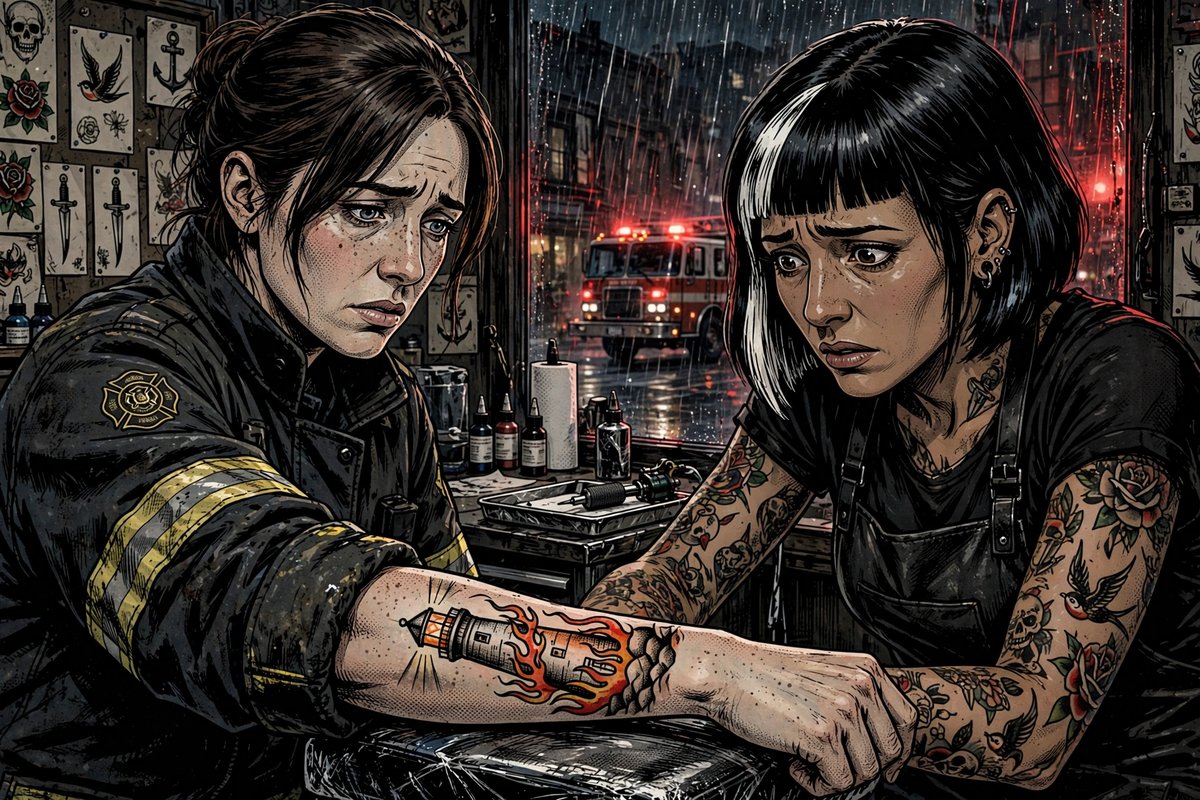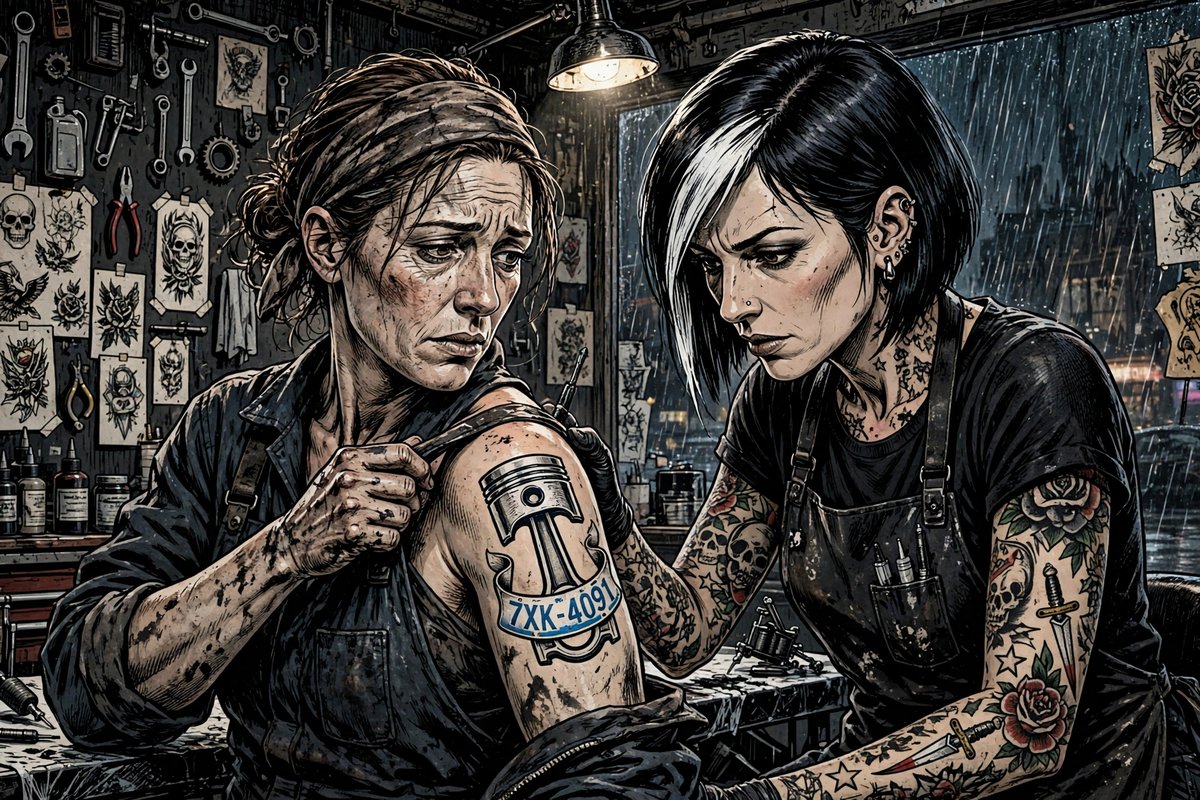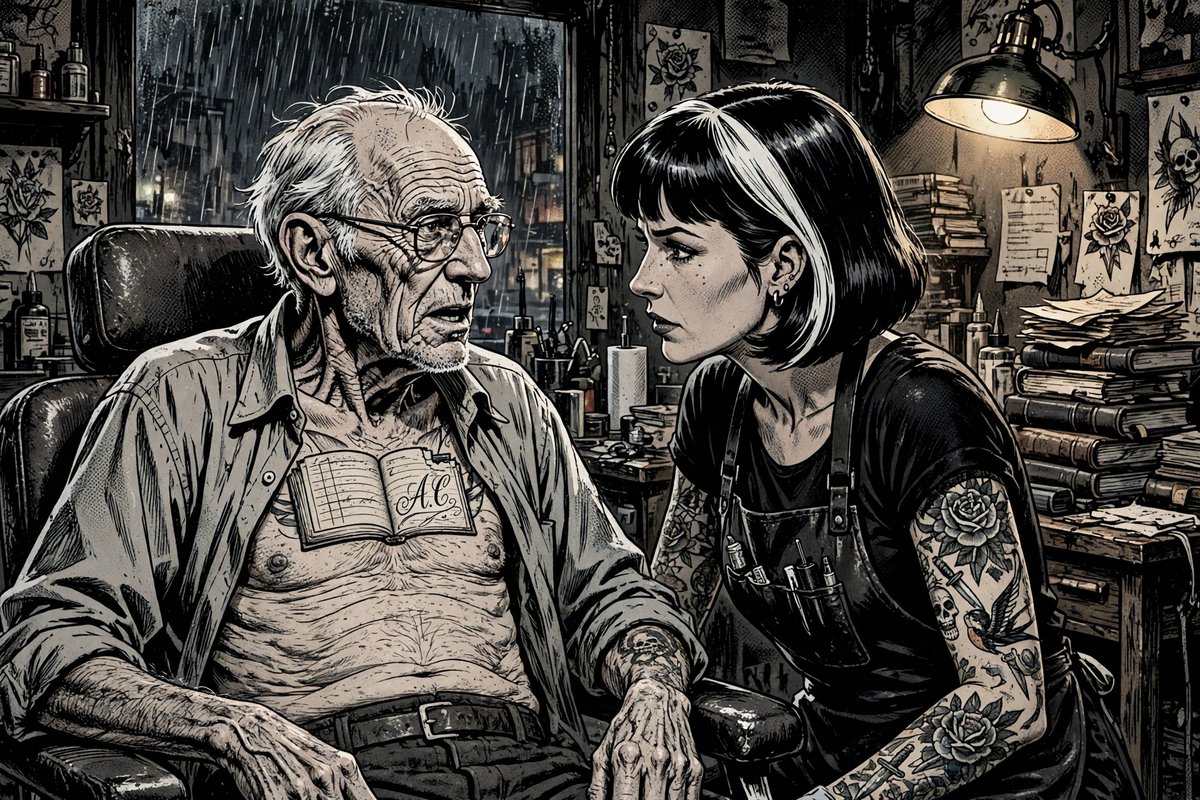
Rain in Vesper City doesn't fall. It hangs around, like a guest that won't leave.
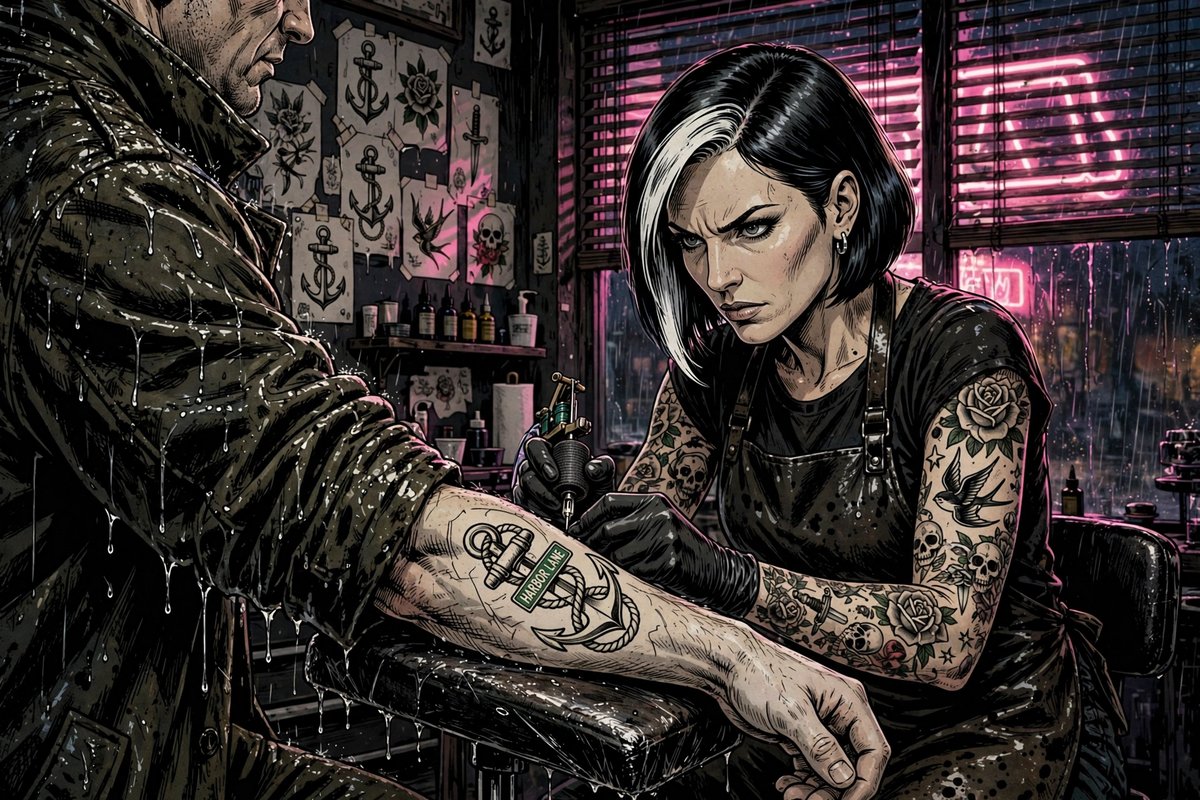
It was coming down in sheets the morning Big Sal pushed through my door, shaking water off a coat the size of a sail. The neon from my sign — THE BLACK LANTERN, buzzing pink against the gray — chased him inside and died on the threshold. He stood in the doorway dripping, a mountain of a man gone soft around the middle, fifty-four years old and every one of them earned on the docks.
"Viv." He held out his forearm like it owed him money. "Tell me I'm seeing things."
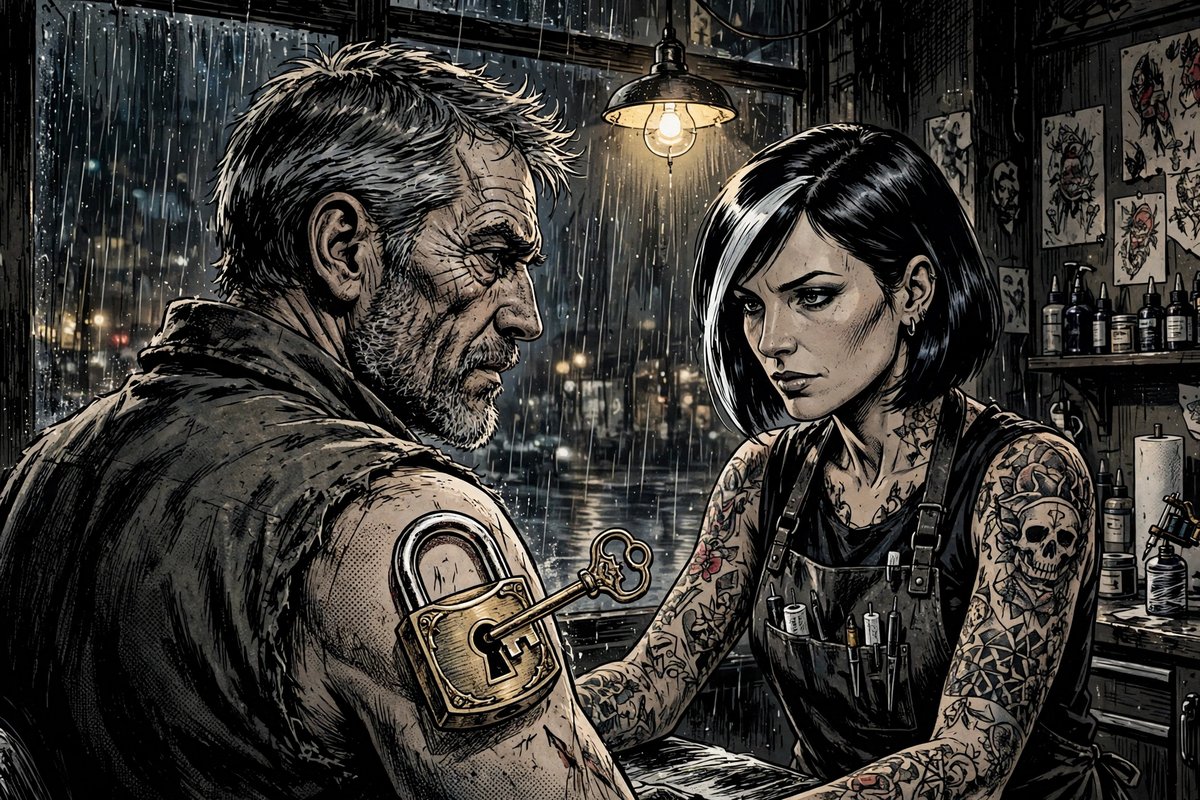
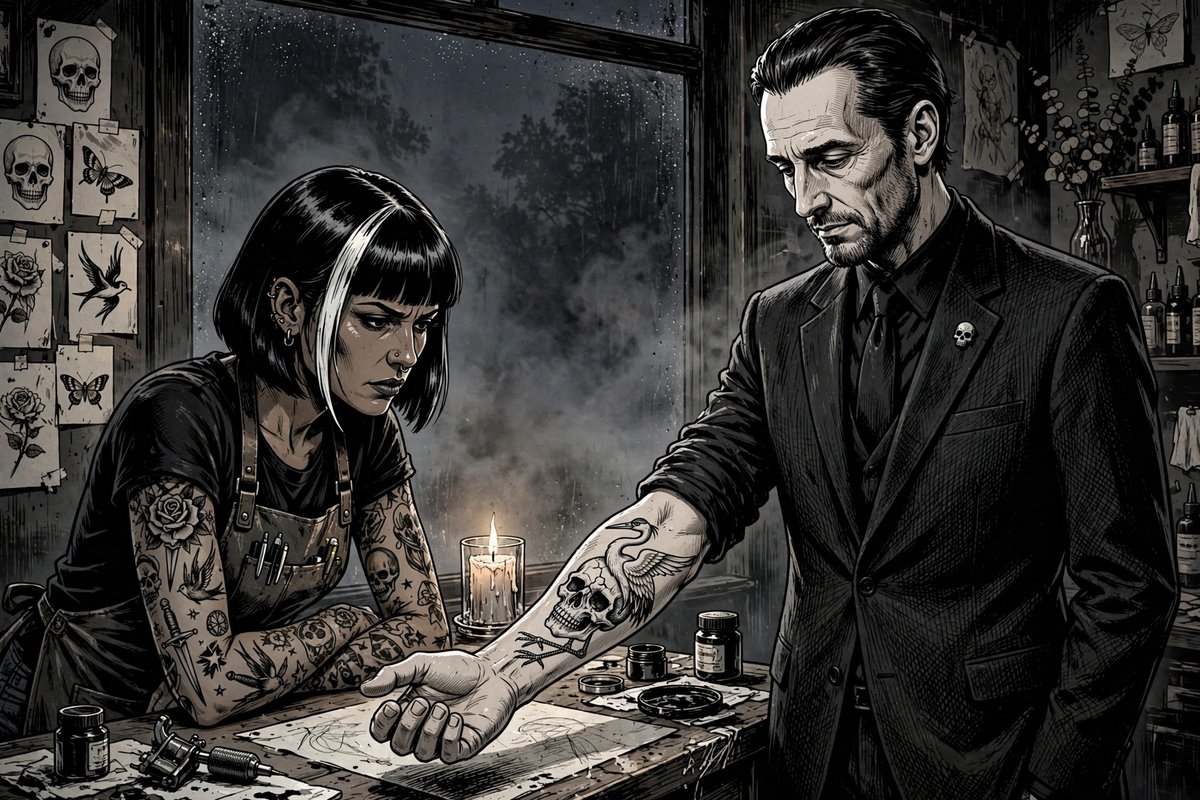
Sal's been coming to me for six years. Anchor on his right forearm, rope work I did myself, clean and deep, the rope winding three times around the shank the way real rigging does. A dockworker's handshake in ink. I'd touched it up twice. I knew every millimeter of that piece.
Only now the rope had something new in it.
A street sign. Small, green, the white letters crisp as a fresh stencil: HARBOR LANE.
It hadn't been there in November. I'd have remembered. I remember every line I put in skin — that's the job, that's the whole job, knowing exactly what's under your needle and what's supposed to be there when you lift it.
"When did you notice it?" I asked.
"This morning. Woke up, it's there." He laughed, but it came out wrong — a dry scrape. "My wife thinks I got drunk and came to see you."
"You didn't."
"I know I didn't." He leaned in, and the shop smelled like rain and green soap and his wool coat. "Viv. Tattoos don't just... appear."
No. They don't.
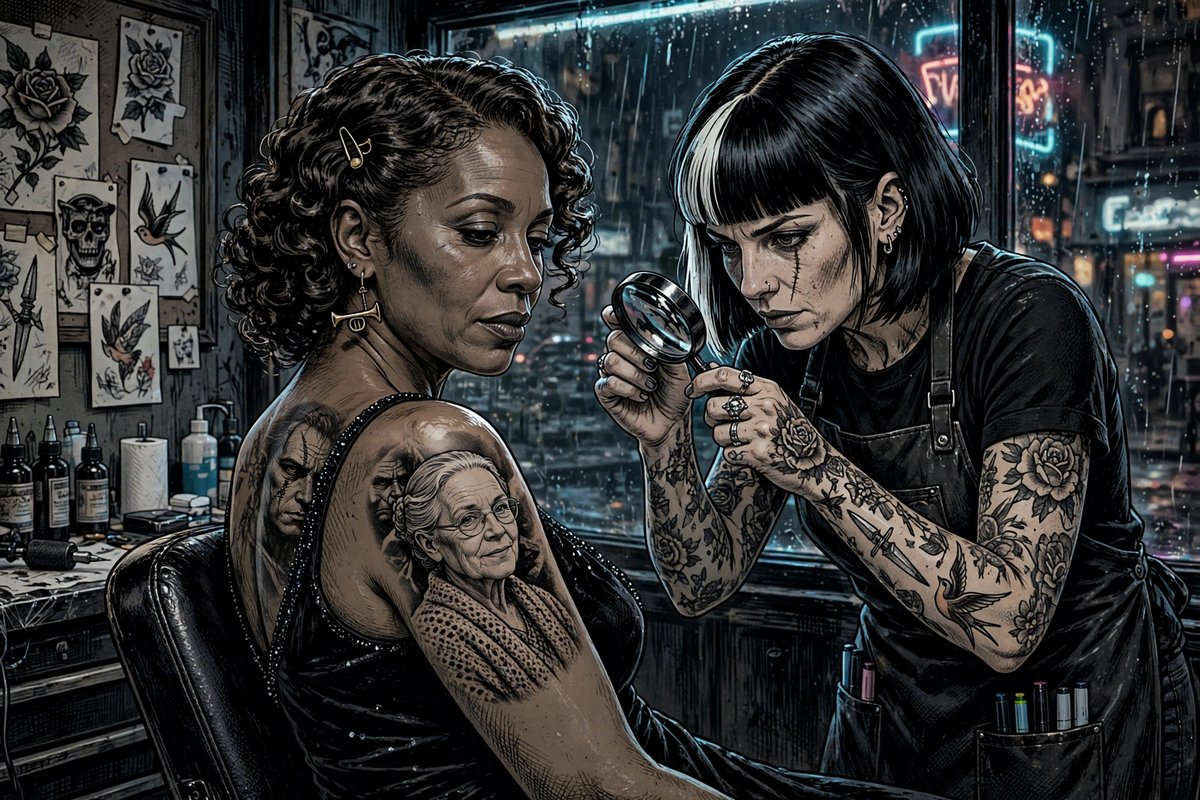
I got my loupe. I got my good lamp, the one with the daylight bulb. I looked at that street sign the way I'd look at a forgery — because that's what it had to be, some kind of trick, except there was no trick I knew that worked like this.
The ink was healed. Not fresh, not raised, not scabbed. Settled into the skin like it had been there for years, the edges soft the way old ink goes soft. But the lines were crisp. Old ink isn't crisp. New ink isn't healed.
It was both. It was impossible.
"Does it hurt?" I asked. "Itch? Anything?"
"Nothing. Feels like the rest of it." He flexed his forearm, watching the sign move with the muscle. "Viv, I'm not a fanciful man. But I woke up with a street sign in my arm, and I'd like somebody to explain it to me."
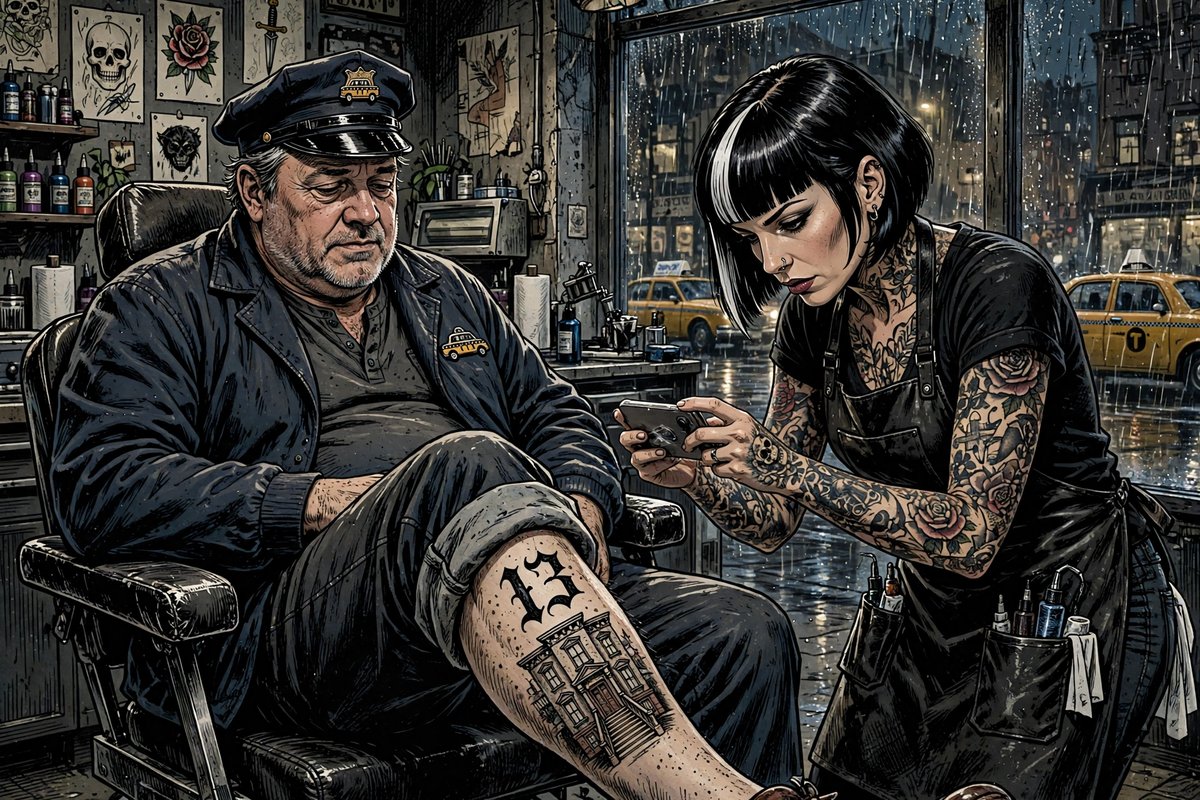
I photographed it. Three angles, good light, macro. Told him I'd think on it, told him not to scratch it, told him to call me if anything else showed up. He left a twenty on the counter for nothing and went back out into the weather, and I watched him go — a big man walking carefully, like the ground might have changed while he wasn't looking.
I sat in my chair for a long time after, looking at the photos on my phone.
Here's the thing about Harbor Lane: it's my street. The Black Lantern sits at 414 Harbor Lane, between a shuttered chandlery and a noodle shop that never closes. Sal doesn't live on Harbor Lane. He works the docks two streets over and lives out past the rail yards with his wife and his roses — the man grows roses, did I mention that, a dockworker with forty rosebushes.
So why was my street showing up in his skin?
I pulled up the photo from his last touch-up, November. The anchor, the rope, clean. No sign. I laid the two photos side by side on my light table and stared until my eyes watered.
The sign was new. The ink was healed. Those two facts sat next to each other like strangers at a bar, refusing to make sense together.
Ink doesn't appear overnight. Healed ink really doesn't appear overnight.
I locked up early. The rain kept coming down, drumming the awning, turning Harbor Lane into a black mirror with the neon bleeding across it in pink streaks. I stood in my doorway a moment, keys in my hand, and looked across the street.
Under the awning of the closed chandlery — Harlow & Sons, gutted and dark — a man stood watching my shop.
I noticed him because nobody stands in that doorway. It belongs to the rain and the rats and the memory of a business that died. But there he was, still as a post, hands in his pockets, face in shadow.
He was gone by the time I blinked. Just the empty doorway, the rain, the dark.
I told myself I'd imagined him. I almost believed it.
That night I dreamed about anchors. About rope coiling around a green street sign, pulling it down under black water, and a voice — not a voice I knew — saying look closer.
In the morning, there was a message on my shop line. I'd know the number if it were a client. It wasn't a number I knew.
No voice. Just breathing, slow and even. And then a click.
I played it three times, telling myself it was a wrong number, a pocket dial, anything.
But here's what I keep coming back to, sitting here in the gray January light with Sal's photos spread in front of me: the sign in Sal's rope didn't look added. It didn't look like something stuck onto the design.
It looked remembered. Like the skin had always known it was there, and had just now decided to tell the truth.
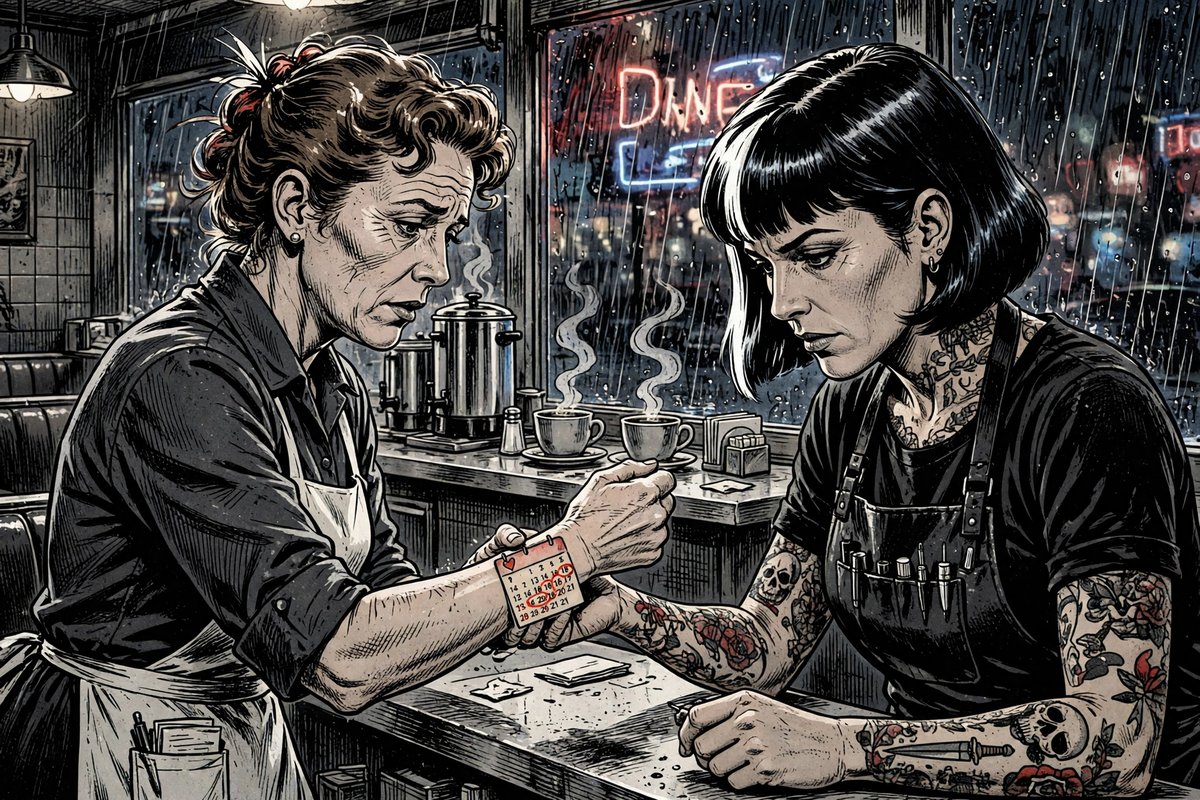
My next appointment was Dottie — waitress over at the Starlight Diner, little calendar page on her wrist with a heart around her anniversary. Routine touch-up. In and out. I'd done the original two years ago and it just needed the lines freshened.
She came in at noon, shaking out her umbrella in my doorway, rain beading on her red vinyl jacket. She smiled when she saw me — Dottie's got a smile that could run the diner on its own — and held up her wrist.
"Viv," she said, very quietly, and the smile was gone. "There's a date circled. In red."
My blood went cold before I even looked.
Because I already knew what it would say.