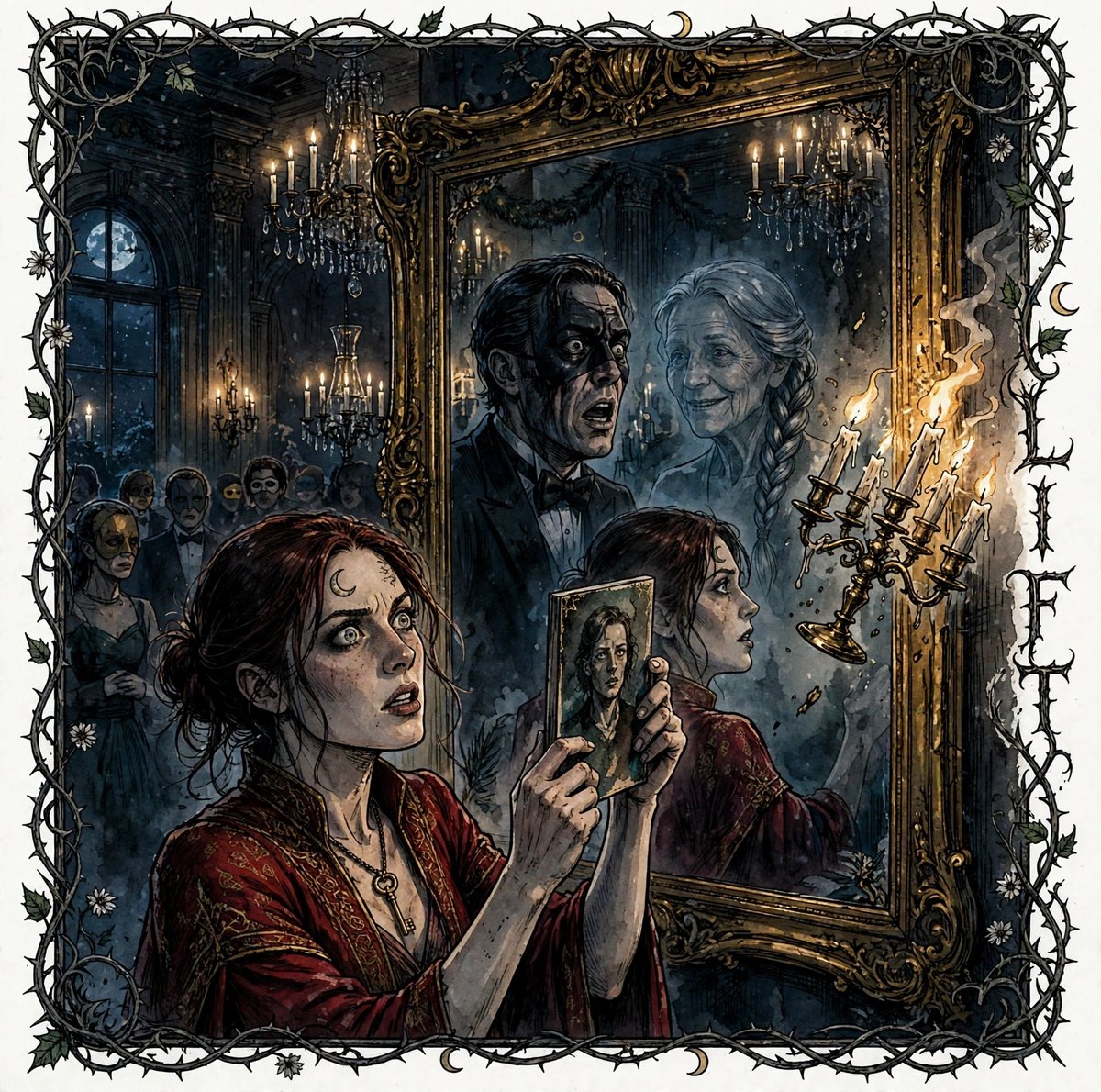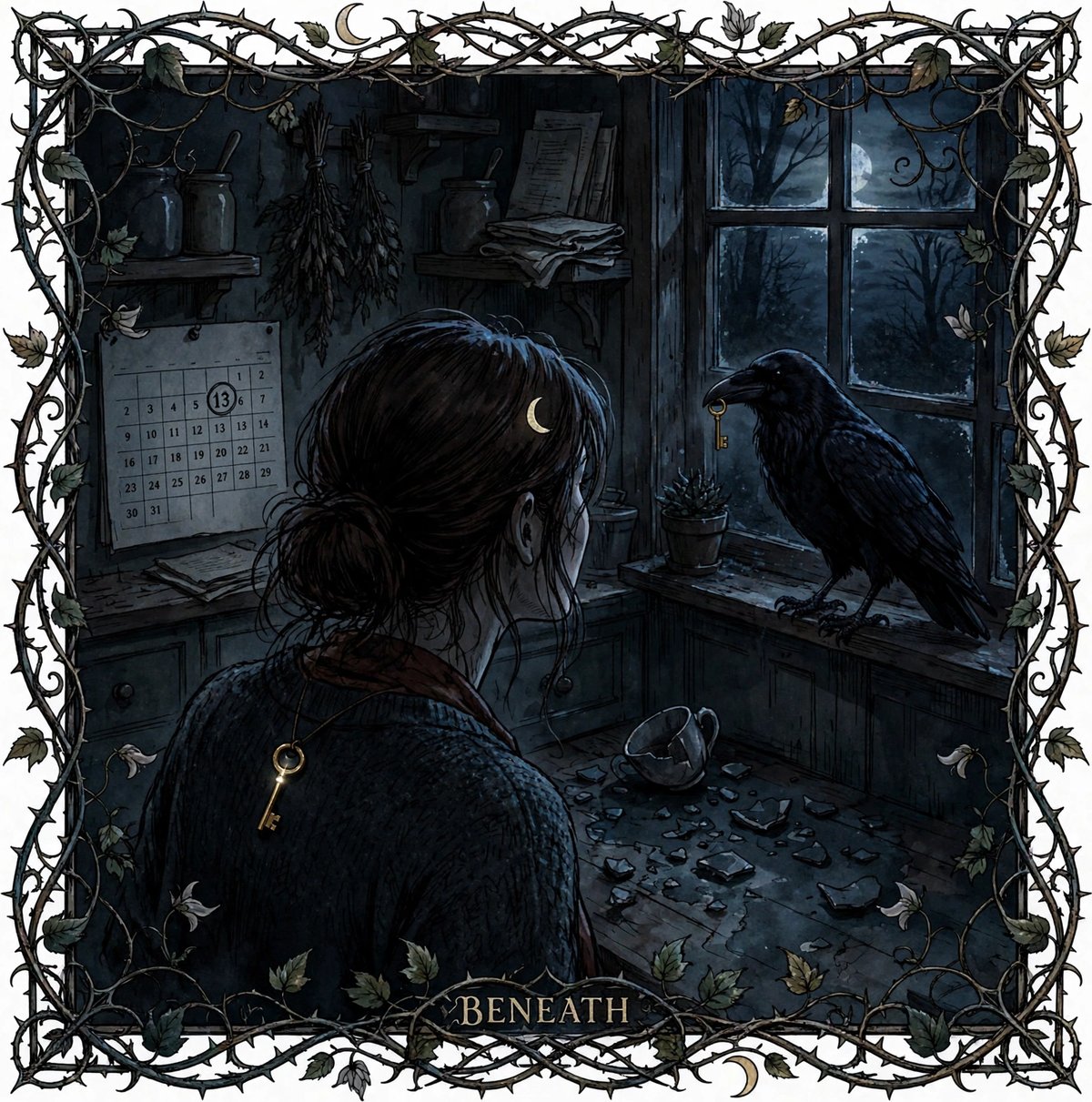
MeekDuke Books presents

THE THIRTEENTH MONTH

A serialized mystery in twelve installments. Mara Ellison inherited a calendar with thirteen months — and every image it shows her comes true. Each month, study the artwork. Nothing is there by accident.

January · Installment 1 of 12
Illustrated panel for January — study it closely

THE THIRTEENTH MONTH

Installment 1 — January: "The Inheritance"

Mara Ellison found the calendar on her third trip up the attic stairs, wedged between a hatbox full of ribbon and a portrait of her grandmother looking furious in 1948.

It hung from a nail like it was still in use. Thirteen month-tabs fanned out across the top, hand-lettered in ink that had gone sepia with age: JANUARY, FEBRUARY, MARCH, APRIL, MAY, JUNE, JULY, AUGUST, SEPTEMBER, OCTOBER, NOVEMBER, DECEMBER — and beneath them all, a thirteenth tab, narrower, written in a hand that shook slightly:

THE THIRTEENTH MONTH.

"Okay, Detta," Mara muttered. Her crescent-moon scar throbbed once, dully, like it always did when she was tired. "What were you up to?"

Odette "Detta" Ellison had died six weeks ago at seventy-eight, and Mara had inherited everything — the Victorian on Ash Street, the paint-stained aprons, the estranged silence of the last eleven years — because there was nobody else left to inherit it. Mara was thirty-four, an archivist at the Greyhollow Historical Society, practical the way her grandmother had been impractical, dry the way Detta had been loud. They had loved each other across a gap neither one would close.

Mara turned the calendar to JANUARY.

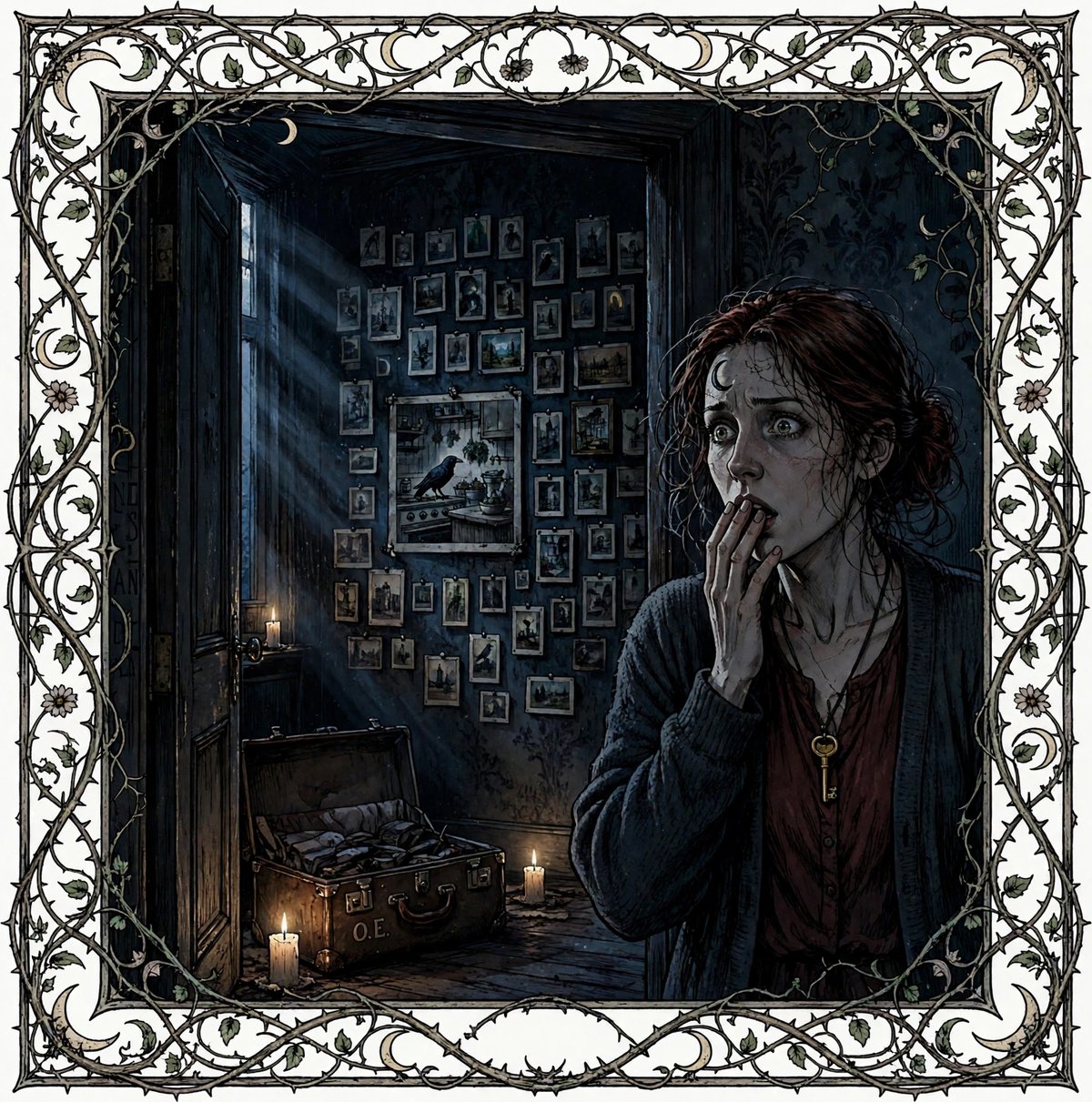
The page was a hand-painted panel, ink and watercolor, gothic-noir in style — Detta had been good, genuinely good, the kind of good that made galleries uneasy. The scene: a kitchen, this kitchen, rendered in grays and rust-red. On the windowsill sat a raven, and in its beak it held a tiny brass key. On the floor at the center of the composition lay a teacup, shattered, the crack radiating outward like a spiderweb.

Detta had painted the grain of the countertop. The chipped tile by the stove. The exact blue rim of Mara's good teacup — the one in the cupboard right now, intact, which Mara had brought from her apartment because the house's cups were all chipped. Her grandmother had been dead six weeks. She had never seen this kitchen with Mara's things in it.

Mara told herself that very firmly, and carried the calendar downstairs anyway.

Mara touched the brass key on the cord around her neck — Detta's key, handed to her by the lawyer with the house. It was the size of a thumbnail.

She carried the calendar downstairs and set it on the counter. Then she did what any sane archivist does with a mysterious object: she made tea.

The teacup shattered at exactly 2:14 that afternoon.

She'd reached for it — her good one, the blue-rimmed — and her ink-stained fingers slipped on the handle, and it hit the floor and cracked open in a spiderweb pattern that matched the painting so precisely that Mara stood in the kitchen doorway for a full minute without moving.

"That's a coincidence," she said to the empty house. The house did not answer.

She went back to the calendar and stared at the January panel. The kitchen. The raven. The key in its beak. The teacup. One out of four had come true. Archival skepticism said: wait for the other three.

They didn't wait long.

On the morning of January 3rd, Mara came downstairs to find a raven on the kitchen windowsill — outside, peering in, head cocked. It dropped something small into the gap of the window frame as she approached. Mara slid the window open and retrieved it.

A tiny brass key. Old. The exact twin of the one Detta had left her, only smaller — the size that would open a diary, or a jewelry box, or something her grandmother had hidden.

The scar on her left temple began to throb in earnest.

Mara stood in the kitchen holding two brass keys and one shattered teacup and did the math that no archivist wants to do: four out of four. The panel had shown her this morning, three days ago, from beyond the grave.

"Fine," she said. "Fine. I'm investigating now."

She started with the calendar itself, because archivists start with provenance. The paper was heavy stock, the kind artists use. The ink was iron-gall, old. Detta had painted every page herself — Mara recognized the hand, the way she laid a watercolor wash over ink lines, the little paint spatters in the margins that even forty years couldn't wash out.

The border of the January panel was elaborate: a tangle of thorn-vines and bare winter branches, inked in fine black line. Mara bent over it with her magnifying loupe, cataloging the detail the way she would any artifact — and stopped.

Halfway down the left border, where a thorn curled back on itself, the negative space between two lines formed a shape. Not a shape. A word.

She traced it with her fingertip, heart hammering against her ribs.

BENEATH.

One word, hidden in the border. Deliberate — the letterforms were too consistent to be accident. Detta hadn't just painted a prediction. She'd buried a message in it.

The scar throbbed again, sharper this time. Mara flipped the calendar to FEBRUARY, half expecting nothing, half expecting everything.

The February panel stopped her breath.

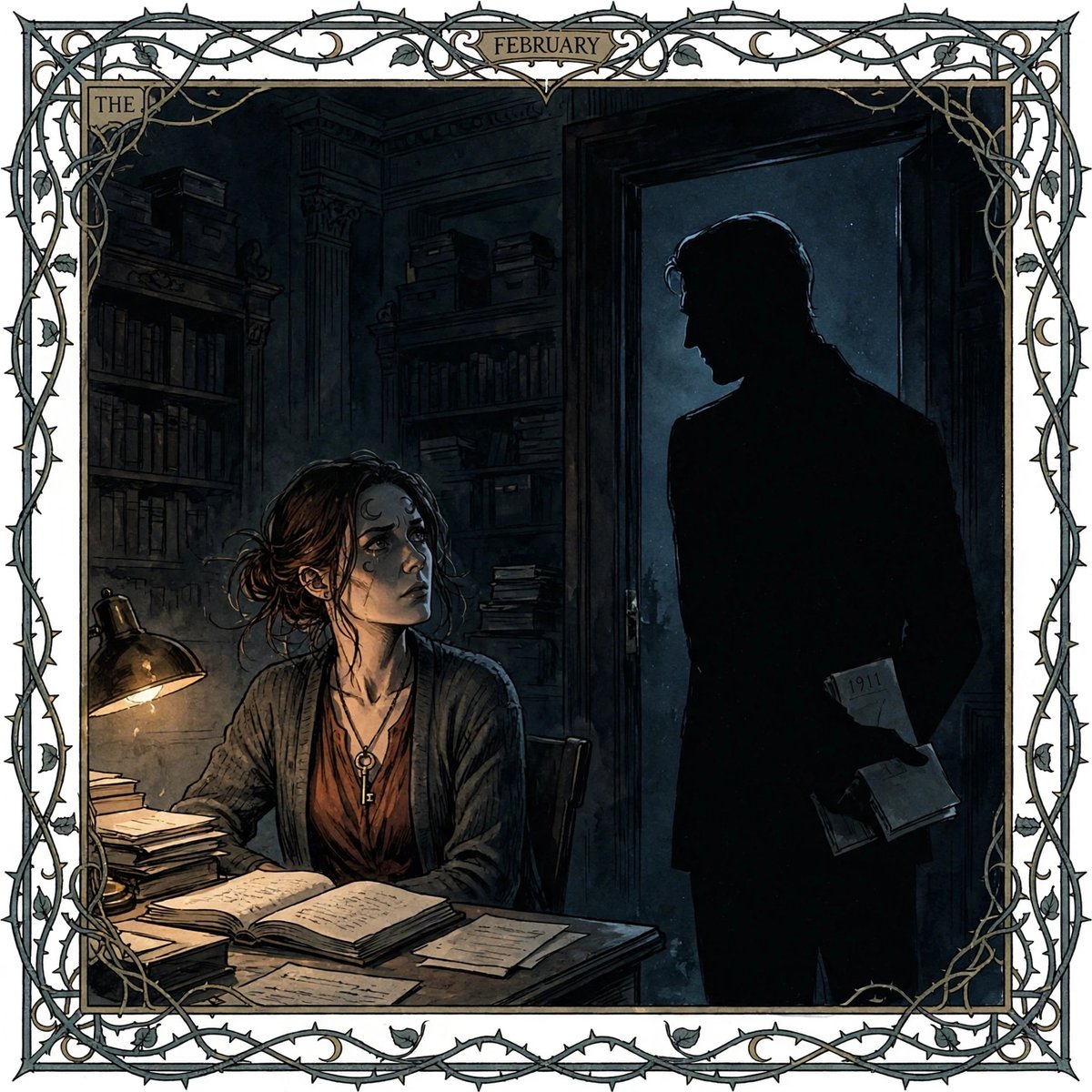
Her office. The Greyhollow Historical Society archives — the exact green-shaded lamp, the card catalog, her desk with the coffee rings. In the doorway stood a man's silhouette, tall, one hand behind his back, holding something long and pale — a paper, folded. Through the panel's window, snow was falling, and Detta had painted a date on the wall calendar inside the painting: the 12th.

Mara counted forward. February 12th was nine days away.

She stood in the attic — the dead-of-winter cold seeping through her charcoal cardigan, her rust blouse smelling faintly of the cedar chest — and looked at the thirteen tabs fanned across the top. Twelve months. A thirteenth. Eleven words left, maybe, if January's hidden word meant what she thought it meant.

"Okay, Detta," Mara said quietly, touching the brass key at her throat. "What did you see? And who were you afraid of?"

The thirteenth tab waited at the bottom, narrower than the rest, in the shaking hand. She didn't open it. Not yet.

February would come soon enough.
February · Installment 2 of 12
Illustrated panel for February — study it closely

THE THIRTEENTH MONTH

Installment 2 — February: "The Silhouette"

The February panel hung over Mara's desk all month like an accusation.

Detta's ink-and-watercolor scene was unmistakable: the archives room at the Greyhollow Historical Society, the green banker's lamp on Mara's desk throwing its pool of light, the card catalog drawers with their brass pulls. In the doorway, a tall man's silhouette, featureless, one arm bent behind his back. In his hidden hand, something pale and folded. Snow fell past the panel's painted window, and on the tiny wall calendar inside the painting, Detta had circled the 12th in red.

Mara had found the word BENEATH hidden in January's border — curled into the thorn-vines in negative space, too precise to be accident. She'd spent three evenings with a loupe going over every panel's border, but Detta had built the other eleven too well; nothing else gave up its secret yet. Fine. One word was a puzzle. Two words would be a sentence forming.

February 12th was a Thursday. Mara wore her charcoal cardigan and told herself she was being ridiculous, and left the archives door open, and watched the clock.

At 3:40, the silhouette filled her doorway.

"Miss Ellison." Harlan Voss stepped into the light, silver hair pomaded to a mirror shine, navy suit immaculate, the signet ring on his right hand catching the lamp-glow — a heavy gold V. He smiled the way a statue smiles. "I hope I'm not interrupting."

Sixty-one years old, town benefactor, name on the library wing and the hospital's new pediatric floor. Mara's friend Sofia Reyes, the ADA, called him "Greyhollow's walking tax deduction" and trusted him exactly that far.

"Mr. Voss. What brings you to the archives?"

"Your grandmother's papers." He gestured at the stacks with one long hand — and Mara's eyes went to his other hand, the one still behind his back. "Odette was a great friend of this town's history. I'd like to make a donation to the society in her name, and I thought her papers might contain some of the society's records. Early-century documents. Things that belong to all of Greyhollow."

"The society already received Detta's papers, Mr. Voss. From her estate."

"All of them?" The smile didn't move. "Estates miss things. Attics are large."

Mara's scar gave a single warning throb. She watched him move to the Dette Ellison collection — four archival boxes she hadn't finished processing — and begin leafing through folders with the confidence of a man who knew what he was looking for. His right hand, the one with the ring, stayed visible. His left stayed behind his back.

And then she saw it: the folded pale thing in his left hand. He was sliding it — no. He was sliding something into his sleeve. A ledger page, torn at the edge, folded once.

Mara stood up. "Is that one of the collection's documents, Mr. Voss?"

He turned, smoothly, the page gone. "I'm sorry?"

"Behind your back. You came in holding a folded page, and now you're not."

For a heartbeat, the statue-smile slipped. Then: "You must have imagined it, Miss Ellison. I'm sixty-one years old; I don't sneak around archives." He moved toward the door. "I'll have my office send the donation check. Five thousand, in Odette's name. A lovely woman. Such a loss."

He left. The doorway was empty. Snow fell past the real window, exactly like the painting.

Mara stood motionless until she heard his car start. Then she went to the Detta collection and checked the folders he'd touched. One was out of order — a folder labeled "Ledgers, 1958–1963," and inside it, a gap in the page numbering. Page 47 was gone. Torn out recently; the edge was fresh.

The panel had shown her this. The silhouette. The hidden paper. Detta had painted Harlan Voss stealing from her own archive before Mara had even finished unpacking her grandmother's house.

What were you afraid of, Detta? Or who?

That night, under the good lamp, Mara turned the calendar to February and worked the border with her loupe for two hours. The February panel's border was different from January's — not thorn-vines but falling snow, dozens of tiny inked flakes spiraling down both margins. She'd dismissed it as decoration.

It wasn't.

Three-quarters down the right margin, four snowflakes overlapped at angles that made no meteorological sense — and in the negative space between them, in Detta's unmistakable hand, worked into the ink as carefully as a signature:

THE.

BENEATH. THE.

Her hands were shaking. She set the loupe down and called Sofia Reyes.

"Sofia. It's Mara. I need you to tell me something, off the record." She stared at the two hidden words, at the February panel with its stolen page. "What do you know about Harlan Voss and the year 1911?"

A pause. "Why 1911?"

"Because I think my grandmother was murdered. And I think he tore the proof out of her papers today, in my office, while I watched."

Another pause, longer. "Come to my office tomorrow. Bring everything." Sofia's voice dropped. "And Mara — don't tell anyone else you're asking."

Mara hung up and flipped the calendar forward, to MARCH.

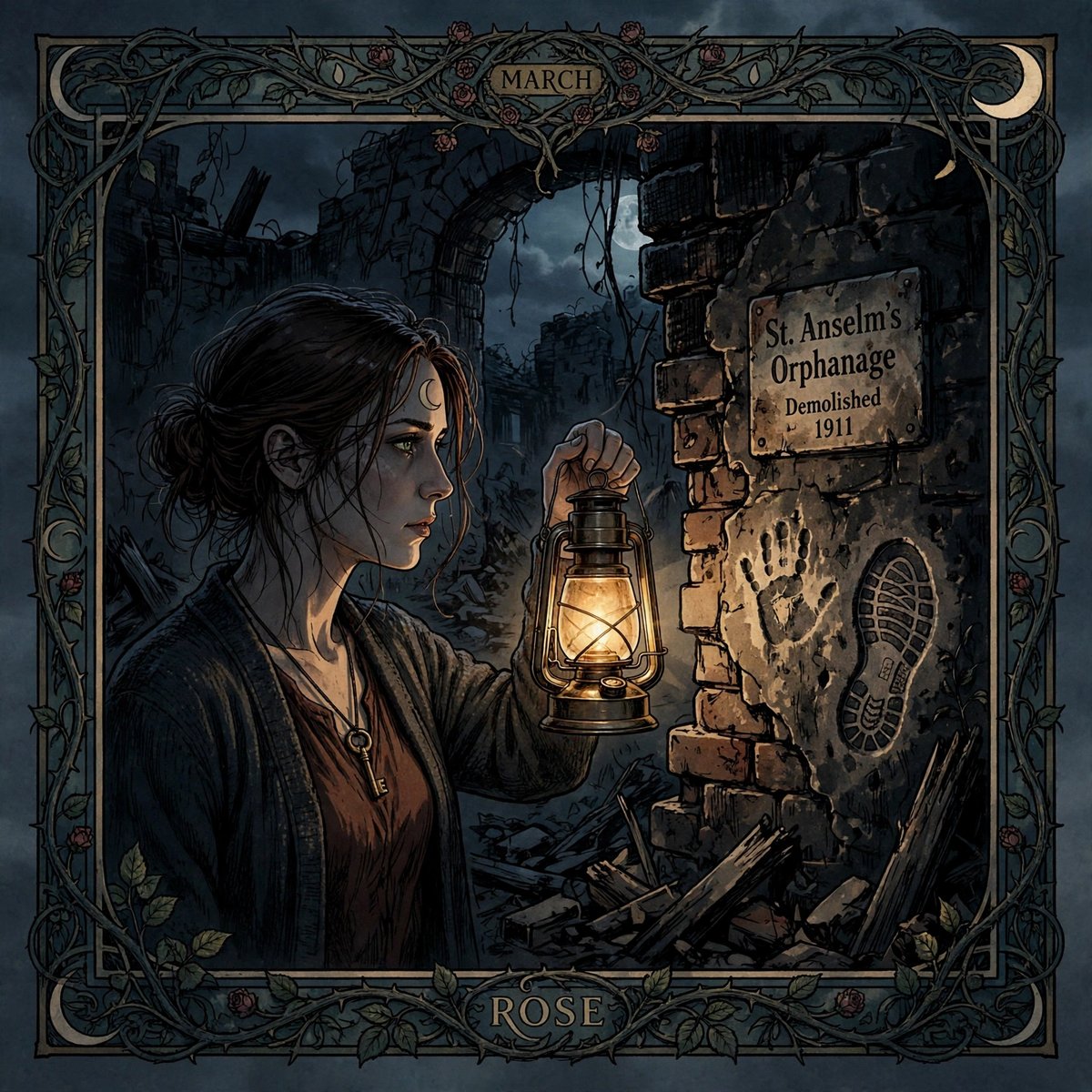
The March panel was painted in grays and ash-black, and it showed a place Mara had never seen: the ruins of a building, stone walls open to the sky, charred beams collapsed inward. A chapel, maybe — there was a broken rose window frame, empty of glass. And on one blackened wall, rendered in Detta's precise ink lines, a handprint. Small. Pressed into a drift of ash.

But the wall around the handprint was clean stone beneath the ash — stone that had been rebuilt, or exposed. Mara leaned closer. In the corner of the panel, in the same tiny hand Detta used for dates, she'd written: St. Anselm's.

St. Anselm's. The name meant nothing to Mara — and everything, because Detta had never painted a place she hadn't seen, and that wall had been demolished in 1911.

The scar at her temple throbbed, steady as a pulse.

A handprint in the ash. Fresh. On a wall that shouldn't exist.

March · Installment 3 of 12
Illustrated panel for March — study it closely

THE THIRTEENTH MONTH

Installment 3 — March: "Ash"

"BENEATH THE," Sofia Reyes read, peering through Mara's loupe at the two calendar panels spread across her office desk. "Okay. I'm going to say the thing you're thinking so you don't have to. Your grandmother hid a treasure map in a calendar."

"It's not a treasure map," Mara said. "It's a location. Two words of a location."

"Still a treasure map." Sofia sat back, her sharp dark bob swinging. She was forty-four, the county's assistant district attorney, and Mara's oldest friend — the kind of friend who'd brought soup the week Detta died and asked no questions about the eleven-year silence. "Now tell me why you think Harlan Voss murdered your grandmother."

Mara laid it out: the January panel coming true to the detail. The February panel — Harlan's silhouette, the stolen ledger page 47, the snow. Detta's "the sight," the thing the family never discussed: brief visions, always as still images, that Detta had painted instead of described.

"She painted the future," Sofia said flatly.

"She painted a future. And somebody didn't want her painting anymore."

Sofia was quiet for a long moment. Then she opened her desk drawer and pulled out a file folder, old, the tab typed: ST. ANSELM'S ORPHANAGE — FIRE, 1911.

"You asked about 1911," Sofia said. "This is everything the county has. Which is almost nothing."

Mara read. On the night of October 17, 1911, St. Anselm's orphanage — a stone building on the east edge of Greyhollow, run by the Sisters of Mercy — burned to the ground. Twenty-three children and four nuns died. The official finding: accidental, a lantern knocked over in the dormitory. The building was demolished within the month. The lot sat empty for decades.

"And Voss?" Mara asked.

"The Voss family owned the insurance company that paid out on the building. Harlan's grandfather, Cornelius Voss." Sofia tapped the folder. "That's public record. The rest is town gossip: the payout was enormous, and it seeded the Voss fortune. But gossip isn't evidence, and Cornelius died in 1949."

"Beneath the," Mara murmured. "Detta was painting St. Anselm's in the March panel. A handprint in ash — on a wall that was demolished in 1911."

"Show me."

The March panel was all grays and char-black. Detta had painted the ruins of the chapel — the broken rose window frame, empty of glass, the collapsed beams — with her usual merciless precision. And on one wall, pressed into a drift of pale ash against the blackened stone: a small handprint, fingers spread.

"It's fresh," Mara said. "Look at the edges. Detta painted old ash as flat, settled. This has ridges. This was pressed recently — and the wall behind it, that's exposed stone, like something was covering it and got pulled away."

Sofia studied it. "Mara. This wall was demolished in 1911. There's nothing there but a vacant lot."

"Then let's go look at the vacant lot."

The St. Anselm's lot was on the east edge of town, behind a chain-link fence gone rusty, posted with NO TRESPASSING signs from a developer who'd bought it in the eighties and done nothing with it. Mara went on a gray Saturday morning in early March, Sofia beside her with a thermos and a bail-jumper's disregard for posted signs.

There was nothing. Weeds, broken glass, a concrete foundation outline where the orphanage had stood.

And then Mara saw the chapel.

It wasn't on any map she'd seen — a smaller foundation, off to the east of the main outline, half-sunk, with one partial wall standing about four feet high. Stone. Blackened on one side.

Mara's scar throbbed once, hard.

She climbed down into the foundation. The wall's inner face was covered in a century of grime — except for one section, about two feet square, where the grime had been scraped away. Beneath it: blackened stone. And pressed into a drift of pale ash at the wall's base — ash that had no business being there, clean and loose and recent — was a small handprint, fingers spread.

Mara crouched, not touching it, her breath coming short. Beside the handprint, in the soft dirt, was a partial sneaker print. Modern. Size small.

"Somebody was here," Sofia said quietly, crouching beside her. "Recently. Somebody scraped this wall clean and pressed their hand into fresh ash." She looked at Mara. "Somebody reenacting your grandmother's painting. Or your grandmother painted somebody doing it."

Mara pulled out her phone and photographed everything — the handprint, the sneaker print, the scraped wall — with an archivist's thoroughness. "Detta painted the future. This happened after she painted it. Somebody is following the calendar."

"Or," Sofia said, "somebody is staging the calendar. Making the panels come true."

Mara went very still. She hadn't considered that. The teacup, the raven, the key — could someone have arranged those? The teacup slipping from her own fingers — no. The raven dropping the key — no. But the handprint...

"We need the rest of the words," Mara said. "Whatever's BENEATH THE something — that's what Detta was protecting. That's what Harlan tore out of her papers."

That night, she worked the March border until her eyes burned. The March panel's border was ash and ember: tiny inked flakes of ash drifting down, with here and there a glowing orange coal. She'd assumed the coals were decorative.

In the lower left corner, three embers clustered — and in the dark spaces between them, worked in negative space so fine it was nearly invisible:

ROSE.

BENEATH THE ROSE.

Mara sat back, her scar pulsing. A rose. Detta's garden had roses — the old garden behind the Ash Street house, gone wild in the years of estrangement. And the March panel had shown a rose window, broken, empty of glass.

She turned the calendar to APRIL.

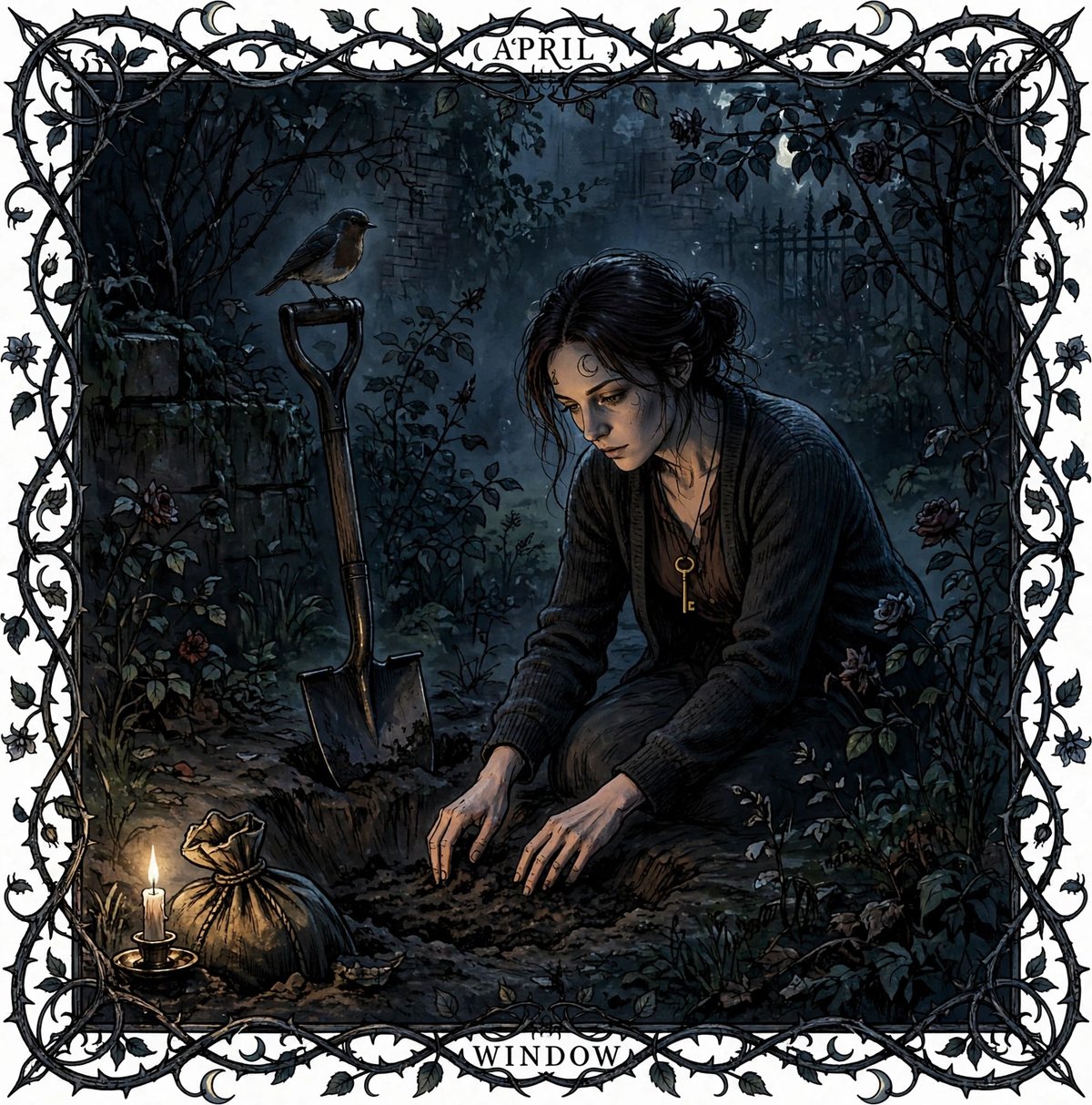
The April panel was the first one painted in color — real color, not the gray washes of winter. Detta's garden in spring: the rose beds along the back fence, the stone path, the old oak. And in the middle of the largest rose bed, a shovel stood upright in freshly turned earth. At the edge of the turned soil, half-buried, was a corner of oilcloth — dark green, waxed canvas, the kind people wrap things in when they want them to survive underground.

Mara looked out her kitchen window at the real garden, the rose beds black and dormant in the March cold.

Detta had buried something among the roses. And the calendar said April was when Mara would dig it up.

April · Installment 4 of 12
Illustrated panel for April — study it closely

THE THIRTEENTH MONTH

Installment 4 — April: "The Rose Bed"

Mara dug up her grandmother's garden on the first Saturday of April, in the rain.

She'd waited as long as she could. The April panel showed the rose bed in spring green, the shovel upright in turned earth, the corner of oilcloth winking from the soil — but Detta's panels showed the event, not the date, and Mara had decided that waiting for permission from a calendar was where skepticism ended and superstition began. Besides: BENEATH THE ROSE. Three words. She wanted the fourth.

The shovel bit into the largest rose bed, the one along the back fence where Detta's old hybrid teas had gone leggy and wild. Mara worked in her charcoal cardigan with the sleeves pushed up, rust blouse sticking to her back, ink-stained fingers gone mud-stained. Her scar throbbed with every strike of the shovel — anticipation, or warning.

Eighteen inches down, the shovel clinked.

She went to her knees in the wet soil and cleared the earth with her hands. Oilcloth. Dark green waxed canvas, folded around something rectangular, tied with twine that crumbled at her touch.

Inside: a journal. Not a diary — a sight journal, the words written on the flyleaf in Detta's bold hand: WHAT I SAW, AND WHEN I SAW IT.

Mara carried it inside, washed her hands, and opened it at the kitchen table with the April panel propped beside her.

The entries were dated. Each one described a painting — before the painting existed.

Jan 9 — Saw the kitchen. The raven with the key. The cup breaking. Painted it Jan 11.

Feb 2 — Saw the archives. A man in the doorway with a paper behind his back. Snow. Painted it Feb 4.

Mar 18 — Saw the chapel wall. A small hand in fresh ash. Painted it Mar 20.

Mara's hands were shaking. Every panel, predicted in prose before it was painted. Detta hadn't been guessing. She'd been recording — the sight came as still images, and she wrote them down, then painted them, then hid one word in each border.

She turned pages faster. The entries ran for years — small visions, mostly: a neighbor's lost dog found, a storm coming, a child's fever breaking. Detta had seen still images all her life and told no one but the journal.

Then, near the back, the entries changed.

Oct 3 — Saw Harlan in the garden. He was digging where I buried this. His ring caught the light. He knows I saw the fire.

Oct 5 — Saw myself painting the thirteenth month. Saw the last panel. I will not paint what comes after.

Oct 6 — H. knows.

Three lines. That was all. Detta's "death" — the stroke, the quiet funeral Mara hadn't attended because the invitation had come eleven years too late — had been October 9th.

Mara sat in the silent kitchen and did the arithmetic of grief. Her grandmother had seen Harlan Voss digging in this garden. Had seen her own death coming. And had staged it — because the alternative was letting him finish the job, and Detta had chosen the calendar instead. Chosen Mara.

"She faked her death," Mara whispered. "She faked her death and left me the calendar."

But where had she gone? And was she still —

The scar throbbed, once, like a hand on her shoulder. Mara closed the journal and held it against her chest until the shaking stopped.

Then she did the archivist's work. She photographed the journal, logged it, and turned the calendar to the April panel to hunt the border.

April's border was the most beautiful yet: a cascade of rose vines in bud, inked leaves and the first hints of bloom, curling around all four margins. Mara worked it with the loupe for an hour, petal by petal.

She found it in the upper right, where two stems crossed: in the negative space between the leaves, four letters worked so delicately they might have been veins in a petal.

WINDOW.

BENEATH THE ROSE WINDOW.

Mara stared at the four words until they blurred. A rose window. St. Anselm's chapel had a rose window — the March panel had shown its broken frame, empty of glass. Beneath the rose window of something. The chapel. Beneath the rose window of St. Anselm's chapel.

Her phone rang. Sofia.

"Mara. You're going to want to sit down." Sofia's voice was tight. "I pulled the 1911 insurance records. The orphanage fire payout — it went to two companies. Both of them Voss-owned. And Mara, the building was insured twice. Two policies, two payouts, same fire."

"Insurance fraud," Mara breathed.

"Allegedly. It's 1911 — the statute of limitations is a century dead. But here's the thing." A pause. "Harlan Voss called my office today. Asked if I'd heard anything about Odette Ellison's 'unpublished research.' He said it very casually. It was not casual."

Mara's scar gave a warning pulse. "What did you tell him?"

"That your grandmother's papers are with the Historical Society and he'd need a court order. He laughed." Sofia exhaled. "Mara, be careful. He tore a page out of your archive in February. He's looking for what Detta hid."

After she hung up, Mara turned the calendar to MAY.

The May panel was painted in the warm golds and deep reds of candlelight. A gala — long tables, crystal, the blurred faces of Greyhollow's wealthy half. In the foreground, a printed invitation lay on a tablecloth: The Voss Foundation Spring Gala, and across Harlan Voss's printed name, a slash of red ink — a furious X. Beside it, a wine glass was tipping, red wine spilling across the cloth in a shape that looked, unmistakably, like a spreading stain. Or blood.

In the corner, in Detta's tiny hand: May 23.

Mara checked her phone. The Voss Foundation Spring Gala was May 23rd. Three weeks away.

She looked at the tipping glass, the red X, the spilling wine — and touched the scar at her temple, which had gone quiet for the first time in days.

Whatever happened at that gala, Detta had seen it. And Mara had a terrible feeling she was going to be in the room when it happened.

May · Installment 5 of 12
Illustrated panel for May — study it closely

THE THIRTEENTH MONTH

Installment 5 — May: "The Benefactor"

The Voss Foundation Spring Gala was held in the ballroom of the Halcyon Hotel, under chandeliers that had survived three renovations and one fire. Mara went because the May panel had circled the 23rd in Detta's tiny hand, and because Sofia — who'd been invited as the county's ADA and couldn't get out of it — said, "If your grandmother painted you at that gala, you're going, and I'm not letting you go alone."

Mara wore the only formal dress she owned, black, and Detta's brass key on its cord, hidden under the neckline. Her scar had been throbbing since morning.

The May panel's scene unfolded around her in real time: the long tables, the crystal, the candlelight in warm golds and deep reds. She found herself watching every wine glass in the room.

Harlan Voss found her during the cocktail hour. Silver hair, navy suit, the signet ring flashing as he extended his hand.

"Miss Ellison. I'm so glad you came." His smile was a practiced thing. "I've been meaning to ask — your grandmother's unpublished research. Odette was working on a history of Greyhollow's early century, wasn't she? The society would hate to see it... misplaced."

"Her papers are catalogued, Mr. Voss. Nothing's misplaced."

"Of course, of course." He leaned closer; his cologne was expensive and wrong. "But there are rumors, you understand. That Odette believed certain old stories about my family. Stories from 1911. A woman of her imagination — well. I'd hate for the society to lend its name to fantasies."

Mara's scar pulsed. "Are you asking me to suppress my grandmother's research?"

"I'm asking you to be careful." The smile stayed. "Greyhollow loves its benefactors, Miss Ellison. It doesn't love grave-robbers."

He moved on. Mara stood very still, her fingers finding the brass key under her dress.

Sofia appeared at her elbow with two glasses of wine. "You look like you need this. What did he want?"

"He knows about Detta's research. He's scared of it." Mara took the glass but didn't drink. "Sofia — the insurance records. Walk me through them again."

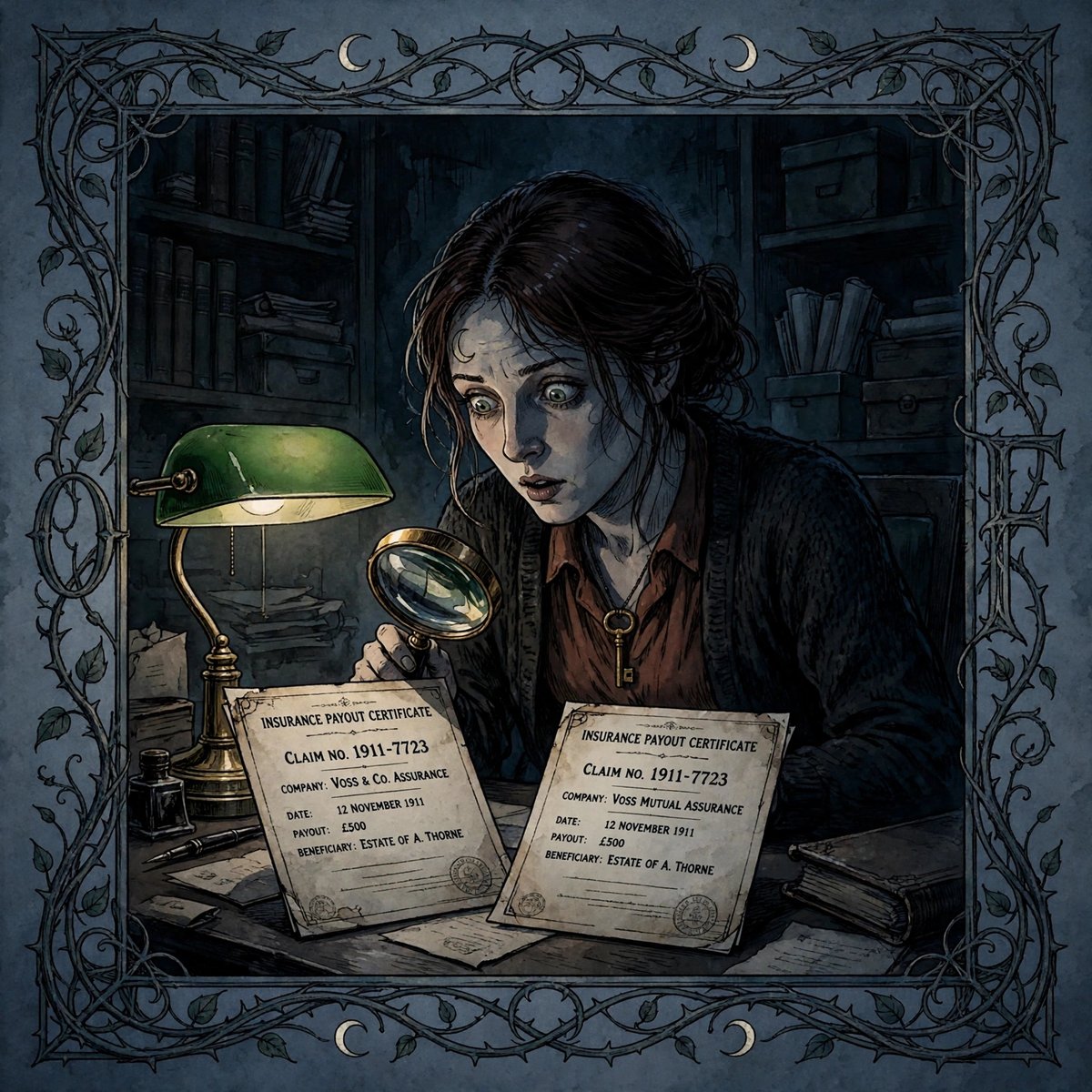
So Sofia did, quietly, in the corner of the ballroom while the string quartet played. In 1911, St. Anselm's orphanage had carried two fire insurance policies — one with Voss Mutual, one with Greyhollow Indemnity. Both companies were owned, through layers of partnerships, by Cornelius Voss, Harlan's grandfather. When the orphanage burned on October 17, 1911 — twenty-three children, four nuns — both companies paid out. In full. To the Voss estate, which had quietly bought the orphanage's mortgage the year before.

"Double indemnity on an arson fire," Sofia said. "The payout seeded everything — the bank, the hotel, the foundation. The whole Voss fortune is built on that fire."

"And Detta knew."

"Detta saw." Sofia's voice dropped. "Mara, if your grandmother had visions of 1911 — if she saw the fire being set — "

"She'd have proof. Or she'd know where the proof is." Mara looked across the room at Harlan Voss, holding court by the champagne tower. "BENEATH THE ROSE WINDOW. Four words. We're halfway to the location."

That's when the wine glass tipped.

It happened exactly the way Detta had painted it: a waiter backing away from the head table, his elbow catching a glass at the edge. Red wine spilled across the white cloth, spreading in a dark stain — and the stain spread toward the place cards, toward the printed program, toward Harlan Voss's name on the gala invitation at his own seat.

Mara watched it happen with the strange double vision she'd been living with all year — seeing the room, and seeing Detta's panel of the room, overlaid. The spill in the painting had spread left to right. The real spill spread left to right. Detta hadn't painted a metaphor. She'd painted a seating chart.

Someone gasped. Harlan laughed it off — the statue-smile, the patrician wave — but Mara saw his eyes.

Someone gasped. Harlan laughed it off — the statue-smile, the patrician wave — but Mara saw his eyes. For one second, looking at the red spreading across his name, Harlan Voss looked afraid.

In the painting, Detta had put a red X across his printed name. In life, the wine did it for her.

Mara left the ballroom early, her scar hammering. In the hotel lobby, she stopped at the display case of Halcyon memorabilia — and froze.

A matchbook. 1962. The Halcyon Hotel. Displayed beside a black-and-white photo of the lobby.

She'd seen that matchbook before. In the June panel.

That night, back at the Ash Street house, Mara turned the calendar to May and attacked the border. The May panel's border was candle-flames and wine-dark roses, gold leaf worked into the ink. She found the word in the lower margin, where two flames leaned together — in the negative space between them, small and fierce:

OF.

BENEATH THE ROSE WINDOW OF.

Five words. A location taking shape: beneath the rose window of St. Anselm's chapel. The chapel foundation, the blackened wall, the scraped stone. Something was under that wall. Something Detta had seen, and Harlan had killed — or tried to kill — to keep buried.

Mara turned the calendar to JUNE.

The June panel was painted in ink and watercolor in Detta's documentary style — no scene, no people. Just a ledger page, rendered with obsessive precision: columns of numbers, dates from 1911, company names. Voss Mutual. Greyhollow Indemnity. And circled in red, three times, a single line: a payout figure, and beside it, in Detta's hand, a note: Paid twice. Same fire.

Tucked into the corner of the panel, painted with the same care as the ledger, was a matchbook: The Halcyon Hotel — 1962.

Mara stared at it. The matchbook from the hotel lobby display. The ledger page — page 47, the one Harlan had torn from Detta's papers in February, the one he'd carried out of her office behind his back.

Her scar throbbed, steady and certain.

Harlan Voss had the proof in his office. And the calendar said June was when Mara would take it back.

June · Installment 6 of 12
Illustrated panel for June — study it closely

THE THIRTEENTH MONTH

Installment 6 — June: "The Ledger"

"I want to be clear," Sofia Reyes said, "that as an officer of the court, I am advising you not to do this."

"Noted," Mara said.

"And as your friend, I'm driving the getaway car."

The Voss Foundation offices occupied the top floor of the Voss Bank building on Main Street — all walnut and brass, with a view of the whole town that Harlan Voss had presumably earned with orphanage money. Getting in was Sofia's contribution: the foundation's annual compliance filing was due, and the ADA's office had questions, and Harlan's secretary had been told to expect a records request on the morning of June 14th.

"Twenty minutes," Sofia said, double-parked on Main with the engine running. "He's at a Rotary lunch until one. The secretary takes her lunch at twelve-fifteen. That's your window. If anyone asks, you're a courier."

Mara's scar was throbbing so hard it was almost audible. "If this goes wrong — "

"It won't. Go."

The secretary's desk was empty. Harlan's office door was unlocked — arrogance, or habit. Mara slipped inside and closed the door behind her.

The office was exactly what she'd expected: degrees on the wall, photos with governors, a humidor, a desk the size of a small boat. And behind the desk, a wall safe — old, the kind with a combination dial, set into the paneling.

Mara stood looking at the safe and felt the brass key on its cord against her sternum. Detta's key. The tiny twin of it had come from a raven in January. This one —

She tried it in the safe's keyhole on instinct. It didn't fit. Of course it didn't.

But the desk drawers — the center drawer was locked. The brass key slid in like it had been made for it.

Inside the drawer, under a stack of foundation letterhead, was a folded ledger page. Torn at the edge. Page 47.

Mara unfolded it with hands that barely shook, because archivists are trained for this — the moment the document meets the light. The page was from Detta's 1958–1963 ledger, but the entries were older, copied in: St. Anselm's Orphanage — Fire, Oct 17, 1911. Two columns. Voss Mutual — payout £... no, $47,000. Greyhollow Indemnity — payout $47,000.

Paid twice. Same fire.

And in Detta's handwriting, in the margin, in ink that had faded to brown: C. Voss set the fire himself. The night watchman saw. Watchman was paid $200 and put on a train west. I saw his face. I painted it.

Below that, a name: Elias Brandt.

Mara photographed the page — front, back, margin notes, everything — with the thoroughness of a woman who'd waited six months for this. Then she folded it, slid it into her bag, and locked the drawer.

She was halfway across the office when the door opened.

Harlan Voss stood in the doorway — the silhouette from the February panel, complete at last. Silver hair, navy suit, signet ring. He looked at her, at the desk, at the drawer.

"Miss Ellison." Very quiet. "That's my private drawer."

"That's my grandmother's page." Mara's voice didn't shake. She was as surprised as he was. "Page 47. You tore it out of her papers in my office in February. I watched you."

"The ravings of a grieving woman." He stepped inside and closed the door. "Give me the page, Mara."

"No."

"You don't understand what you're holding." For the first time, the statue-smile was gone entirely. "That fire was a hundred and fifteen years ago. Everyone involved is dead. What do you think happens if you wave that page around? The foundation employs four hundred people. The hospital wing — "

"Was built with the money from twenty-three dead children." Mara's scar was a drumbeat now. "Did you kill her, Harlan? My grandmother. Did you try?"

Something flickered in his face. "Odette had a stroke."

"Odette saw you digging in her garden. She wrote it down. October 3rd." Mara held his gaze. "She saw you coming, so she left before you could finish it. She's been gone eight months and she's still smarter than you."

He moved — fast for sixty-one — but Mara was already at the door, and Sofia was in the hallway with her phone out, and whatever Harlan Voss had been about to do died in front of a witness.

"This isn't over," he said.

"It really is," Sofia said pleasantly. "Smile for the compliance visit, Harlan."

They walked out of the Voss Bank building into the June sunlight, and Mara didn't breathe properly until they were in the car.

"You got it?" Sofia asked.

Mara laid the folded page on the dashboard. "Paid twice. Same fire. And a name — Elias Brandt, the night watchman. Detta saw his face."

Sofia was quiet for a moment. Then: "Mara. This is a century-old crime with a dead arsonist and a dead witness. But the fraud — the double payout — if the foundation's current filings reference those assets — " She shook her head. "I need to think. But this is real. You did it."

That night, Mara spread the June panel under the good lamp. The border was the most intricate yet: a ledger's ruled lines transformed into an ornamental frame, columns and figures worked into the decoration. She found the word in the bottom margin, where two ruled lines converged — in the negative space, in Detta's precise hand:

SAINT.

BENEATH THE ROSE WINDOW OF SAINT.

Six words. Six months. Beneath the rose window of Saint Anselm's chapel.

Mara sat back, the photographed ledger page glowing on her laptop beside the calendar. The chapel foundation. The blackened wall. The scraped stone, the fresh handprint, the sneaker print. Something was buried beneath that wall — the proof Detta had died (or "died") protecting. The watchman's name. Maybe more.

She turned the calendar to JULY.

The July panel was painted in the cool blues and deep shadows of a hotel corridor at night. Room 312 — the number clear on the door, which stood ajar, a wedge of warm light spilling out. In the hallway outside sat a suitcase, old leather, and on its side, stamped in gold leaf gone green with age, two initials:

O.E.

Odette Ellison.

Mara touched the initials with one ink-stained fingertip, her scar giving a single slow throb — not warning, this time. Something almost like relief.

Detta had staged her death in October. And in July — last month, already past — she'd been at the Halcyon Hotel. Room 312. Alive.

The thirteenth tab waited at the bottom of the calendar, narrower than the rest, in the shaking hand. Seven words down. Six panels to go.

Mara picked up her phone and called the Halcyon Hotel. "Hi — I'd like to ask about a guest from last July. Room 312."

Her grandmother was out there. And the calendar knew exactly where she'd been.

July · Installment 7 of 12
Illustrated panel for July — study it closely

THE THIRTEENTH MONTH

Installment 7 — JULY: "Room 312"

The July panel had been the one Mara liked the least, and that was saying something. Every panel of Detta's calendar had been beautiful and terrible in equal measure — hand-painted gothic-noir scenes that came true one by one, on schedule, as if her grandmother had stood in the future with an easel and simply refused to look away.

July showed a hotel-room door at the end of a long green-carpeted hallway. A brass number read 312. In the foreground, Detta's painted hand held a skeleton key toward it, and above the key hovered a luna moth — pale green wings spread, dead-center, pinned to nothing. Pinned to the calendar itself, maybe.

That detail was what Mara kept circling, because everything else on the wall was a lie or a threat. A painted moth meant nothing.

Until the afternoon the moth showed up in Room 312 for real.


The Halcyon Hotel had been Greyhollow's grand dame a century ago, and had spent the last forty years as a peeling wedding cake of a building with a third-floor corridor no guest ever used. Mara knew this because Detta had told her — Detta had told her, years ago, in a kitchen conversation Mara had dismissed as one of her grandmother's spooky little stories: "Harlan Voss pays for Room 312 at the Halcyon. Has for years. A room he never sleeps in. Ask yourself why."

Mara had not asked herself why. She had been twenty-two, and Detta had been "the weird grandmother," and the whole thing had slid off her like rain off a roof.

She asked herself why now.

Getting the key was not the hard part. The night clerk was seventeen and bored, the register was a computer older than he was, and the card for 312 was still physically filed under V — Voss, H., standing reservation, billed annually. The key itself was brass, heavy, and worn smooth. When Mara turned it in the lock, the door swung inward on hinges that did not creak — because, she realized, they were maintained. Oiled. A room nobody used, kept ready like a loaded gun.

The room was a studio of futures.

Detta had covered every wall. Not with wallpaper — with panels. Small ones, big ones, some no bigger than a postcard, pinned up in overlapping rows like a madwoman's gallery. Studies. Future-studies. That was the only word for them. There were scenes Mara recognized — the archive door (February), the burned ledger page (June) — and scenes that hadn't happened yet, or hadn't been found, or belonged to futures that had bent around her family's actions like river water around a stone.

And there, in the exact center of the far wall, pinned where the January panel had been — the luna moth. Pale green wings, spread and still. Alive. It lifted off the panel as Mara approached and landed, soft as a secret, on the back of her hand.

Her scar throbbed.

That was the part she had been trying not to say out loud. The crescent-moon scar on her left temple — a childhood injury, she'd always been told, a fall against the fireplace tools — had been throbbing all spring. Always before something happened. Before she found the pocketed ledger page. Before the handprint at the ruins. She'd blamed migraines. She'd blamed coffee. She was an archivist. She did not believe in throbbing scars.

Standing in Room 312, watching a moth painted thirty years ago land on her hand, Mara stopped disbelieving.

"Fine," she said to the walls, to Detta, to the dust. "Fine. It's mine too."

Saying it felt like opening a door she couldn't close.

She worked methodically — archivist habits are archivist habits — photographing the room wall by wall before she touched anything. It was while she was photographing the desk, the small round table under the window where Detta must have mixed paints, that she saw it: a panel of Mara's own kitchen. Her kitchen. The kettle she'd bought in March. The chipped blue mug. Painted, per the dated signature in the corner, eleven years ago.

Detta hadn't just painted the future. She'd painted Mara's future — the quiet, ordinary, unimportant future of a woman living a life, eating toast, being nobody's heir to anything. And now here Mara was, in the room where it had been painted, being handed it all like a baton.

She turned the July tab over in her hands — she'd brought the whole calendar, because she always brought the whole calendar now, it had become her notebook, her map, her warrant — and ran her finger along the painted border the way Detta had taught her to look at paintings: the frame is the sentence, Mara, the picture is only the verb.

One hidden word per border. That was the game. Six words so far: BENEATH THE ROSE WINDOW OF SAINT. She'd thought they were directions. She was starting to think they were a confession.

She found July's word in the hallway carpet, woven into the painted weave as darker pile, letters you only saw when the light hit sideways: ANSELM'S.

She said it out loud. The moth opened its wings.

BENEATH THE ROSE WINDOW OF SAINT ANSELM'S.

Saint Anselm's. The orphanage. The 1911 fire. Harlan Voss's fortune. Harlan, who had paid for this room for forty years — not sleeping in it, hiding it. Keeping Detta's future-studies locked away from the world, where nobody could see them except him, on his visits, standing exactly where Mara was standing, checking the futures to see if he'd been caught yet.

That night she turned the calendar page to August.

The August panel showed a studio she didn't recognize — high windows, north light — and at the easel, Mara herself: dark auburn hair in its low bun, charcoal cardigan, brass key on its cord, a brush in her ink-stained fingers. Painted years from now, or yesterday — she couldn't tell Detta's time anymore.

Behind her, leaning against the wall, finished and waiting: a panel of a courtroom.

Mara set down the moth. It stayed on her hand for a moment, then lifted away toward the window, toward the dark, toward whatever August was going to be.

She didn't sleep that night. Her scar throbbed like a second pulse.


END OF INSTALLMENT 7

August · Installment 8 of 12
Illustrated panel for August — study it closely

THE THIRTEENTH MONTH

Installment 8 — AUGUST: "The Brush"

Mara's first deliberate vision came in a grocery store.

She was standing in the pasta aisle of the Greyhollow Market, comparing two brands of penne like a woman with no greater problems, when the throbbing started at her temple — and the aisle went away.

It was a still image. She would learn that this was how it worked, Detta's way: not a film, a painting. A frozen frame, all the information packed into one perfect composition. In it: the Greyhollow town archive's basement storage room, seen through a half-open door. Archive boxes labeled VOSS — DONATIONS 1988–1994 stacked by the furnace. And Harlan Voss himself, in shirtsleeves at midnight, feeding box after box into the flames, his signet ring catching the firelight, the "V" winking at her like an eye.

Then the pasta aisle came back. A woman with a cart was staring at her. Mara was gripping the shelf, penne boxes on the floor, and her scar was pulsing like a drum.

"I'm fine," she said, which was a lie she would keep telling for weeks.

She didn't sleep. She sat at her kitchen table with Detta's calendar open to August — Mara at the easel, courtroom behind her — and she thought about what the painting was telling her to do. Not to watch. To make. To pick up the brush, the way the August panel's Mara had a brush in her hand.

The next morning she went back to Room 312.

She told herself it was for the photographs — better light, a second pass, archivist thoroughness. But the truth was simpler: she wanted to see if the room knew something she didn't. Detta had kept it for decades. Harlan had paid for it for forty years. Two people who understood the sight, circling the same locked room.

In the daylight slanting through the dirty window, she saw what the lamplight had hidden: a panel pinned low, near the desk, half-tucked behind a larger study. It showed the town archive's basement — the furnace, the stacked boxes labeled VOSS — and in the corner, in Detta's handwriting, a date: three years ago.

Detta had seen it too. Harlan burning the boxes. Years before Mara's vision. Detta had painted it and pinned it up and — what? Done nothing? No. Detta had never done nothing. Mara turned the panel over. On the back, in pencil: He burns what he can't buy. Photograph him, little moon.

Little moon. Detta's name for her, from the crescent scar.

Mara stood in the dusty light with the panel in her hands and felt the strangest thing — not grief, not fear, but continuity. Like a relay runner feeling the baton land in her palm. Detta had seen the fire and couldn't act — watched, Harlan had said, always watching, never able to look away, never able to step in without revealing she was alive. So she'd left the instruction for the one person who could.

That night Mara went to the town archive with a camera, a thermos, and the absolute conviction that she was about to look like a complete idiot.

At 11:47 p.m., a key turned in the basement door. Mara, crouched behind the newspaper stacks, heard the furnace rumble to life.

Harlan Voss came down the stairs in shirtsleeves, exactly as the vision had shown. He carried the first box himself. VOSS — DONATIONS 1988–1994. He fed the folders into the furnace one at a time, methodical, unhurried, a man tidying his past.

Mara photographed everything. The boxes. The flames. The signet ring. The way he paused between boxes to check his watch, like a man catching a train.

What she did not photograph — because her hands were shaking too hard to work the camera — was his face when he turned and saw the red glow of the camera's recording light in the dark between the stacks.

He didn't shout. He didn't run. He looked at her for a long moment, and then he smiled — the benefactor's smile, the one from the Founder's Day posters — and said, "Your grandmother had the same habit, Mara. Watching. She never learned to look away either."

Then he walked up the stairs, and the basement went dark except for the furnace mouth, glowing like a judgment.

Mara sat in the dark for a long time. She was not afraid. That was the strange part. She was furious — and underneath the fury, something steadier, something that felt like inheritance. Detta had watched. Detta had painted. And Detta had never looked away, even when looking away would have been so much safer.

On the drive home, her scar throbbing with every heartbeat, she understood something about the August panel that she hadn't before. The Mara at the easel wasn't just painting — she was choosing. Every panel Detta had ever made was a choice: to look, to record, to hand the future to someone who could use it. The sight wasn't a curse you suffered. It was a brush you picked up.

She stopped running from the sight that night. She didn't ask it to come — she invited it. She sat at the kitchen table, closed her eyes, and thought about Harlan Voss the way you think about a lock you're trying to pick.

Nothing came. Visions, it turned out, did not take appointments.

She tried again the next night, and the next — sitting in the dark, thinking about the chapel, the box, Detta's face. Nothing. On the fourth night she gave up trying and went to wash the dishes, and halfway through a coffee mug the throbbing started and she saw: a still image, crisp as a photograph — Harlan's study, the desk drawer open, a key on a ring labeled CHAPEL in his handwriting.

She wrote it down with shaking hands. A key. He kept a chapel key in his desk. Which meant the groundskeeper's key wasn't the only one — which meant the candles might be his.

Or might not be. That was the trouble with the sight. It showed you a frame, not the story.

But the next morning, the August border gave up its word without a fight — there in the easel's wooden frame, carved as grain-lines that spelled themselves under her thumb: CHAPEL.

BENEATH THE ROSE WINDOW OF SAINT ANSELM'S CHAPEL.

She was getting closer to the sentence's end. She could feel it the way you feel a book thinning in your right hand.

That evening she turned the calendar to September.

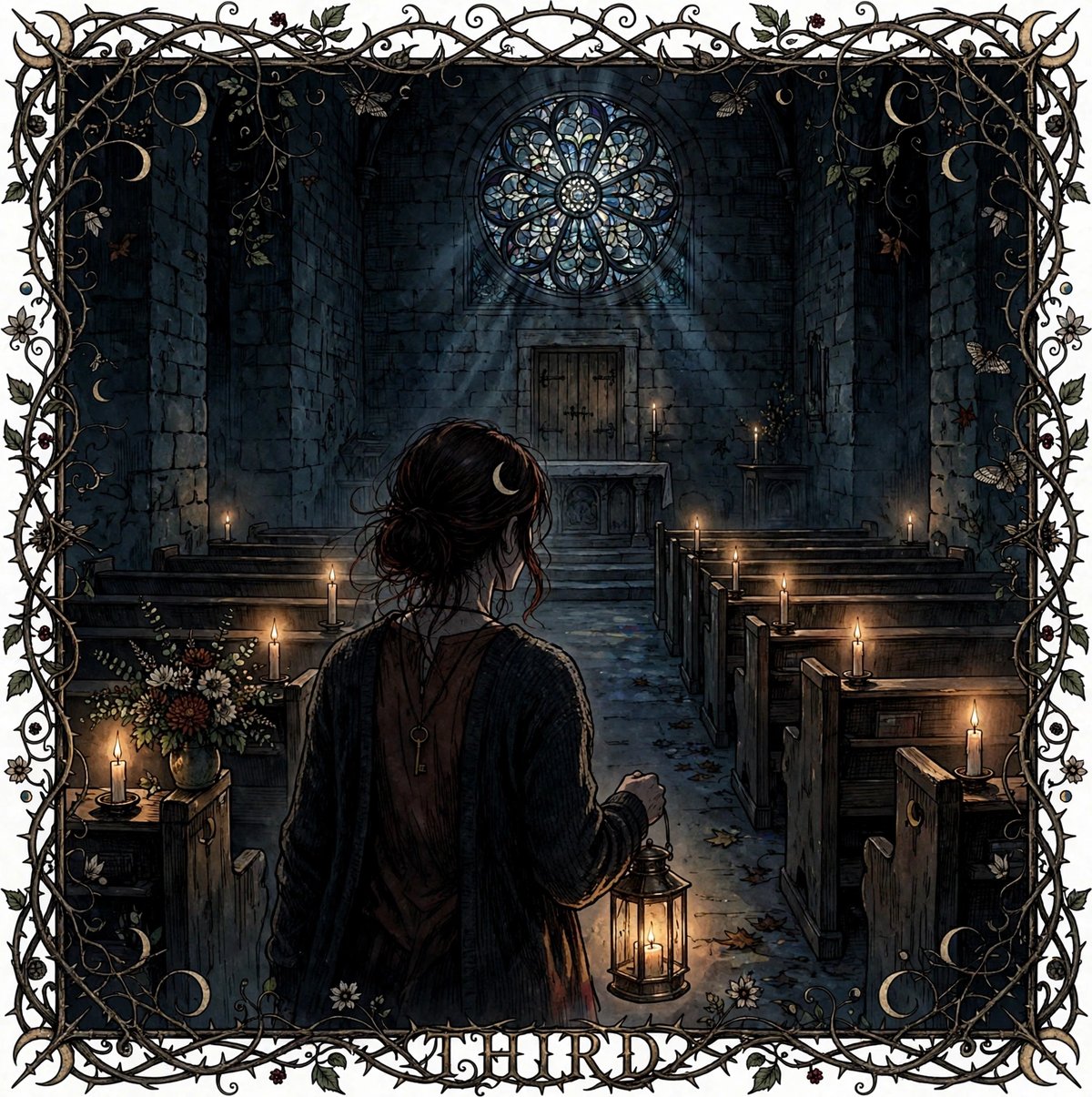
The September panel stopped her cold. It showed St. Anselm's chapel — whole. Not the 1911 ruin with its broken arches and nesting swallows. Whole: stone walls unbroken, the rose window glowing like a jewel, and inside, visible through the open doors, candles lit on the altar. And beneath the rose window — small, easily missed, painted with the care of a confession — a little wooden door set low in the wall, like a child's entrance, or a shrine's, or a secret's.

Mara stared at it for a long time. The chapel had burned in 1911. Detta had painted it whole, candles lit, as if the fire had never happened — or as if it had been rebuilt.

"Detta," Mara whispered to the empty kitchen, "what did you rebuild?"

Her scar throbbed once, softly, like an answer.


END OF INSTALLMENT 8

September · Installment 9 of 12
Illustrated panel for September — study it closely

THE THIRTEENTH MONTH

Installment 9 — SEPTEMBER: "The Chapel"

The chapel was real. That was the first thing Mara had to absorb — and she absorbed it standing in the rain outside a building that, according to every official history of Greyhollow, did not exist.

St. Anselm's chapel had burned in 1911 along with the orphanage. The town's records said so. The plaque at the ruins said so.

But the land records — the ones Mara pulled at the archive the morning after she turned to the September panel — said that in 1920, an "anonymous donor" had funded the reconstruction of a chapel on the old foundation, two miles east of the ruins, on land deeded quietly to a trust. A chapel nobody attended, on a road nobody used, maintained by a groundskeeper paid through a Voss family foundation account.

Detta had painted it whole. Detta had painted it with candles lit.

Mara went at dusk. The rain came in sideways off the fields. The chapel stood exactly as the panel showed it — stone unbroken, the rose window a great wheel of colored glass darkening with the evening, the wooden doors standing open.

Open.

And inside — candles. Lit. A dozen of them on the altar, flames leaning in the draft from the door, wax pooled like small white moons.

Someone had been here. Recently. Someone lit candles in a chapel nobody was supposed to know about.

Mara stood in the doorway for a full minute, rain dripping off her hood, and let the fear do whatever it wanted. Then she walked in.

The interior was plain and cold and impossibly clean — dusted, the groundskeeper's work, or someone's devotion. She walked the aisle slowly, counting pews, and her scar began its slow throb, and she thought: the words. She had them written in her notebook, the sentence Detta was building one border at a time:

BENEATH THE ROSE WINDOW OF SAINT ANSELM'S CHAPEL THIRD —

No. She didn't have THIRD yet. That was September's word, and she hadn't found it. She had BENEATH THE ROSE WINDOW OF SAINT ANSELM'S CHAPEL and a chapel with candles lit and a third pew waiting to be searched.

She searched it anyway. She knelt on the cold floor and ran her hands under the seat, behind the kneeler, along the joints. She checked the second pew and the fourth, in case she was miscounting, in case Detta was being tricky. She found dust, a dead beetle, a hymnal from 1934 with the spine broken.

Nothing.

She sat in the third pew and laughed — one short, ugly sound that echoed off the stone. All spring and summer, every panel had come true on schedule, every word had been findable, every thread had led somewhere. And now, with the sentence nearly complete, Detta had hidden the next word behind a pew with nothing in it and a chapel with candles lit by someone —

Someone. The candles.

Mara stood up so fast her knee cracked. The candles were the September prediction. Detta's panel had shown candles lit — and candles were lit. Someone came here. Someone who knew about this chapel. Someone like Harlan Voss, standing in the aisle where she was standing, lighting candles — for what? For whom? Penance? Surveillance? A ritual of ownership?

Or someone like —

She didn't finish the thought. Instead she did what an archivist does: she looked for the most boring explanation first. The groundskeeper. The trust paid a man to maintain the chapel — maybe the candles were his. Routine. Devotion. A habit.

She found him the next day, mending a fence on the chapel land — a wiry man in his seventies named Amos who'd held the job for thirty years and talked about the chapel the way men talk about a boat.

"The candles?" He squinted at her. "Not mine. I dust. I sweep. I don't light nothing."

"Then who?"

"Nobody comes here, miss. That's the arrangement." He went back to his fence. "Though — " He paused. "Twice this year I found the doors open when I come mornings. Candles burned down. I figured it was kids."

"Kids don't drive two miles down a dead road to light altar candles," Mara said.

"No," Amos agreed. "They don't."

She walked back up the aisle, blew out the candles one by one — it felt like trespass and like duty at the same time — and drove home through the rain with the heater on full and her hands shaking.

At home she laid the calendar flat under the good lamp and went over the September border inch by inch, the way Detta had taught her to look at paintings: the frame is the sentence. The border was a painted stone wall, each stone outlined. She'd checked it three times already.

On the fourth pass, by lamplight at midnight, she saw it: one stone, third row from the bottom, had mortar lines that weren't mortar lines. They were letters, scratched fine as hair: THIRD.

BENEATH THE ROSE WINDOW OF SAINT ANSELM'S CHAPEL THIRD.

She laughed again, and this time it didn't sound ugly. Third. The third pew. She'd already searched it — but she'd searched it like an archivist. Maybe she needed to search it like a granddaughter.

She turned the calendar to October.

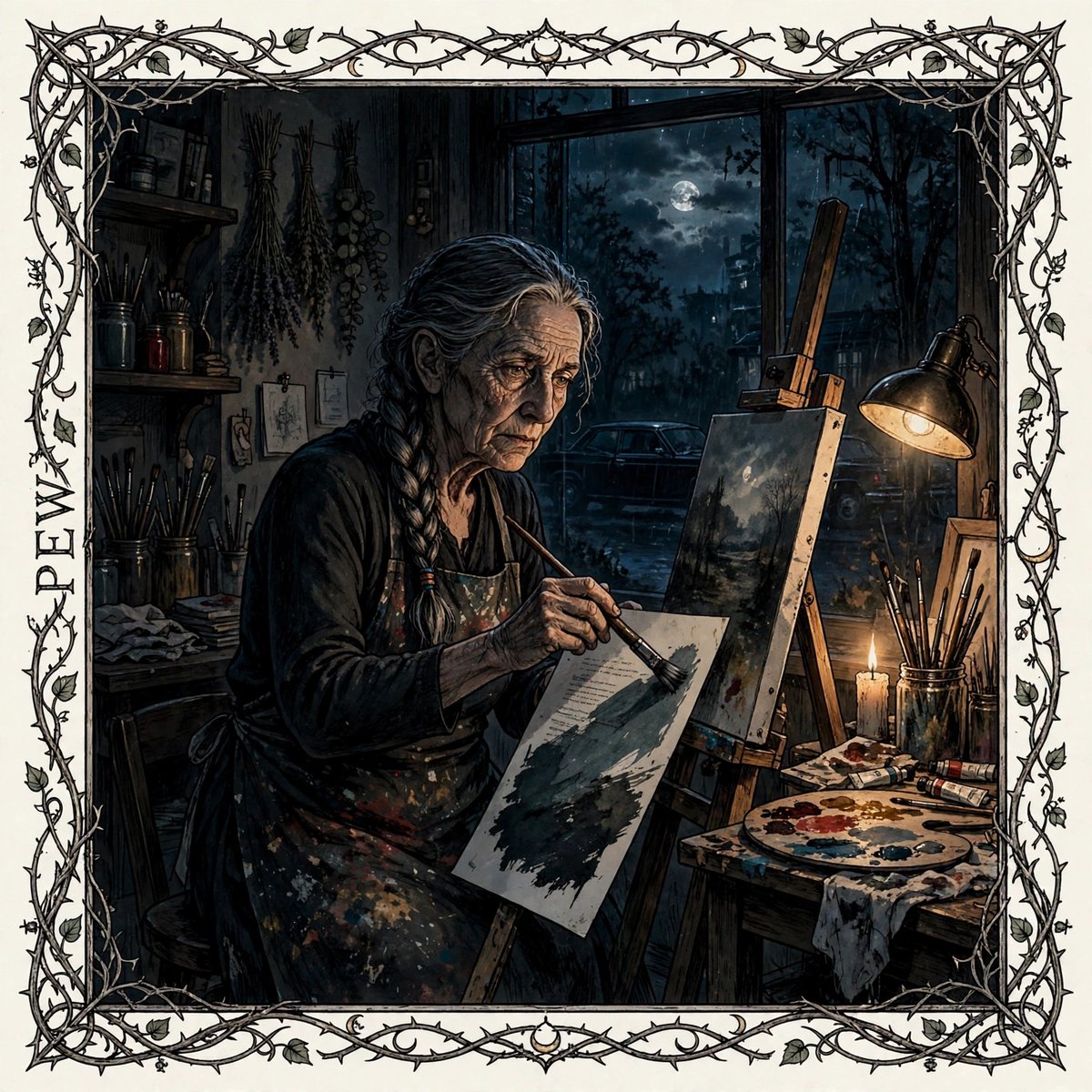
The October panel showed a room Mara recognized — the front parlor of Detta's house, the one with the good light. And at the easel, in a paint-spattered apron, silver-streaked braid over one shoulder: Detta. Alive. Painting. And through the window behind her, the panel showed the yard of the house as it had looked last October — the month Detta died. The asters by the fence, the specific broken slat, the neighbor's ladder against the shed.

Detta, alive, painting, in the month of her death.

Mara's hand went to her temple. The scar was throbbing before she'd even finished the thought.

"Oh, Detta," she whispered. "What did you do?"


END OF INSTALLMENT 9

October · Installment 10 of 12
Illustrated panel for October — study it closely

THE THIRTEENTH MONTH

Installment 10 — OCTOBER: "The Death"

Sofia Reyes read the death certificate twice, then set it down on her desk very carefully, the way you set down something that might detonate.

"Corwin Hale," she said. "Harlan's cousin. Signed it at 9:14 p.m. on October 17th of last year."

"Cause of death?" Mara asked.

"Stroke. No autopsy — Hale waived it. Family declined." Sofia looked up. Her dark bob swung forward as she leaned in. "Mara. There was no family. You were her only family, and you were in Portland, and nobody called you."

Mara had known this. She had known it since the lawyer's letter arrived, since the funeral she hadn't attended because there hadn't been one — a closed casket, a private service, Harlan Voss himself delivering the eulogy about "our beloved Detta, Greyhollow's own." She had known it and not-known it, the way you don't open a letter you're afraid of.

"The October panel shows her alive last October," Mara said. "Painting. In her parlor. In the month she supposedly died."

"Panels can be wrong," Sofia said. But her voice had gone careful, lawyer-careful, which meant she didn't believe it either.

"They haven't been wrong yet."

Sofia tapped the certificate. "To open this up, I need more than a painting. I need a reason a judge will sign."

Mara laid the photographs on the desk: Room 312. The future-studies. The kitchen panel, dated eleven years before her kitchen existed. The August photograph of Harlan feeding archive boxes into the furnace — his face turned toward the camera, the smile.

Sofia was quiet for a long time. Then she said, "I'll file for exhumation. Suspicious death, interested-party petition, evidence of ongoing fraud connected to the deceased's estate." She looked at Mara. "This will make you a target, you know. Officially."

"I've been a target since January," Mara said. "I'd like it on the record."


The exhumation was scheduled for a Tuesday, because the county liked its unpleasantness midweek. Mara stood at the edge of Greyhollow's oldest cemetery in a rain that couldn't decide whether to fall, Sofia beside her in a black coat, a court officer with a clipboard, and two men from the funeral home who wouldn't meet her eyes.

Harlan Voss was there too. Of course he was. Navy suit, silver hair pomaded against the damp, signet ring gleaming. He nodded to Mara across the open grave like they were colleagues.

The coffin came up streaming mud. The lid was unsealed — the screws turned easily, too easily, the funeral-home men said, like they'd been turned before.

Inside, packed in straw like precious cargo: paintings.

Dozens of them. Small panels, wrapped in oilcloth, stacked in neat rows where a body should have been. Detta's work — future-studies, by the look of them, scenes Mara didn't recognize, futures that hadn't happened yet or belonged to other people. On top, one panel face-up: a courtroom. Mara's breath caught — the August panel had shown a courtroom leaning against the studio wall. Detta had painted this moment, or one like it, and packed it in her own coffin like a message in a bottle.

No body. No bones. No Detta.

Harlan's face, when the lid came off, was the most honest thing Mara had ever seen on him. Not shock — confirmation. He'd known. Or suspected. He looked at Mara across the coffin full of paintings, and he said, very quietly, "Clever old witch."

Then he walked away, and Sofia's investigator followed at a discreet distance, and Mara stood in the rain looking at her grandmother's empty coffin full of futures, and she laughed until she cried or cried until she laughed, it was the same thing.

Sofia, ever the lawyer, was already photographing everything. "These are evidence now," she said gently. "Chain of custody. But Mara — " She hesitated. "One of them is yours. She left them for you. When this is over, they'll be yours."

Mara nodded, not trusting her voice. She took one last look at the courtroom panel — at the tiny painted figure in the witness stand with dark auburn hair — and let them seal the coffin back up around its cargo of futures.

Detta had staged her death. Faked the certificate with Hale's help — or Hale's coercion, or Hale's money. Filled the coffin with paintings. Walked away from her own funeral to work unseen.

She's alive. The thought landed like a bell struck once, and kept ringing. Detta is alive, and she painted me into Room 312, and she lit the candles in the chapel, and she's been —

Mara's scar throbbed, hard, once.

She went home and turned the October tab in her hands, and she found the word in the parlor window's painted glass — letters in the leading between the panes, the way Detta signed her real confessions: PEW.

BENEATH THE ROSE WINDOW OF SAINT ANSELM'S CHAPEL THIRD PEW.

Four words left. Or — she counted on her fingers, rain still drying in her hair — no. The sentence so far was ten words. Two tabs remained: November, December.

She turned the calendar to November.

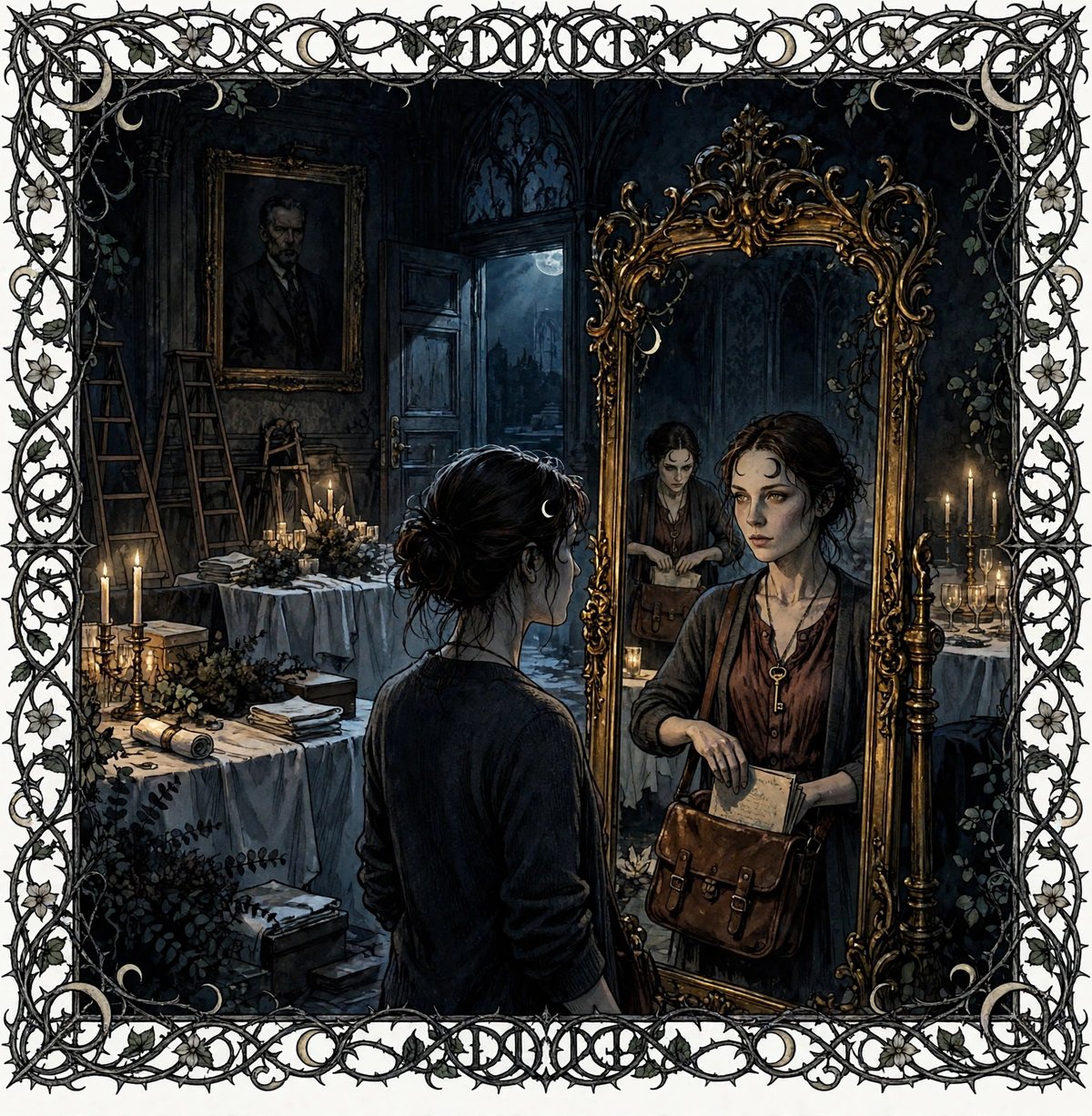
The November panel showed a ballroom. Chandeliers, a long table, a banner reading FOUNDER'S DAY GALA — DEC 12. A toppled candelabra on the table, wax spilling, flames leaning. And in the great mirror behind the table, reflected: Harlan Voss's face, distorted, caught mid-word, mid-confession. And in the foreground, back to the viewer: a woman with dark auburn hair in a low bun, holding up a painted panel for the room to see.

Mara touched the painted woman's hair. Her own hair.

"December 12th," she whispered. "The gala."

Her scar throbbed — not a warning this time. A drumbeat. A countdown.

That night she opened Detta's sight journal — the one she'd dug up in the spring, the one that ended with H. knows. — and read the last entries again, looking for the ones she'd skimmed past, the ones that only made sense now.

He thinks the grave holds me. Let him. The dead are the only ones he can't watch.

The girl has the scar. It wakes when she's ready. Don't tell her. Let the calendar do it.

Mara touched her temple. The scar was quiet now. For the first time all year, it was quiet — as if it, too, were holding its breath for December.


END OF INSTALLMENT 10

November · Installment 11 of 12
Illustrated panel for November — study it closely

THE THIRTEENTH MONTH

Installment 11 — NOVEMBER: "The Trap"

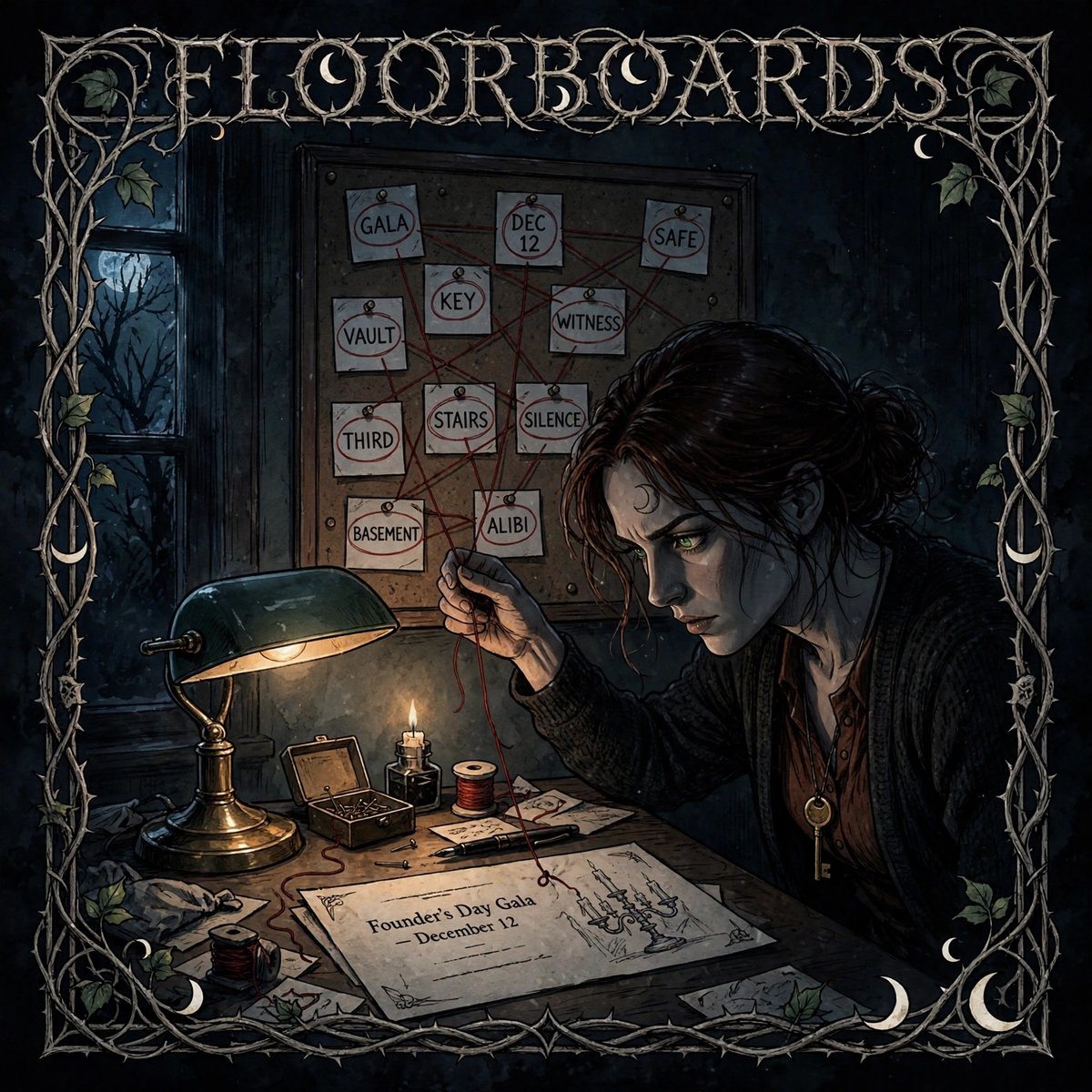
Mara laid the eleven words out on the kitchen table like tarot cards.

BENEATH THE ROSE WINDOW OF SAINT ANSELM'S CHAPEL THIRD PEW FLOORBOARDS

November's word — FLOORBOARDS — had been hidden in the gala ballroom's painted parquet, letters in the wood grain under the toppled candelabra. She'd found it at 2 a.m., lamplight sideways, the way Detta always made her work for it.

Eleven words. One missing. December's, still locked in the last tab.

She didn't need it.

She read the sentence aloud, and halfway through she started laughing, because it was so obvious, so Detta, so perfectly hidden in plain sight that Harlan Voss could have walked past it a hundred times: the proof — whatever Detta had gathered, the thing Harlan had killed for, or tried to kill for — was under the floorboards beneath the third pew of the rebuilt St. Anselm's chapel. The chapel Harlan's own money maintained. The chapel nobody knew about.

Under his nose. For a hundred years of Sundays, under his nose.

"The floorboards lift," she said to the empty kitchen. It wasn't a guess. The sentence was a set of instructions, and instructions end with a verb. Lift.

But she didn't go to the chapel. Not yet.

Because the November panel hadn't just given her the word. It had given her the plan.

She studied it the way she'd learned to study Detta's work — not as a picture but as a staging diagram. The ballroom: the Founder's Day gala, December 12th, Greyhollow's grandest night, Harlan Voss's night, the night he played the benefactor before the whole town. The toppled candelabra — a disruption, a moment when every eye turned. The mirror with Harlan's face caught mid-confession. And the woman with the auburn bun, holding up a painted panel.

Mara was going to recreate the December panel. Exactly. Down to the candle positions. Detta hadn't painted a prediction — she'd painted a script. And Mara, who had spent the year learning that the sight was hers, was going to direct it.

She called Sofia. "I need you at the gala. And I need to know — if a man confesses to arson and murder in front of two hundred witnesses, with a lawyer present, how fast can he be arrested?"

"Very fast," Sofia said. "Mara. What are you planning?"

"A performance," Mara said. "Detta's last painting. I'm going to hang it in front of the whole town and let Harlan walk into it."

She spent November the way Detta would have: preparing. She visited the chapel once more — in daylight, with a groundskeeper's borrowed key and a surveyor's calm — and confirmed what the sentence promised. The third pew sat over floorboards that rang hollow when she knocked, a section newer than the rest, cut and fitted by careful hands. She didn't lift them. Not yet. The proof would keep. It had kept for over a century.

Instead she painted.

She hadn't painted since childhood — stick figures, a regrettable horse — but the August panel had shown her at an easel, and Detta's brush was in the studio drawer, and when Mara picked it up her scar throbbed once, gently, like a hand settling on her shoulder.

The first attempt was terrible. The second was recognizable. By the fifth, working in the parlor's north light with the calendar panel propped beside her own easel, something unlocked — not skill, exactly, but permission. Detta's brush moved the way Detta's brush wanted to move, and Mara stopped fighting it and let her hand be borrowed.

She painted the ballroom the way the November panel showed it: chandeliers, the long table, the banner. She painted the candelabra mid-topple, wax in the air, flames leaning. She painted the great mirror — and in it, Harlan's face, caught mid-word. She painted herself from behind, auburn bun, holding the panel high.

She painted it three times. The third one, she wrapped in brown paper and set by the service entrance of her plan.

Sofia came to see it. She stood in the parlor for a long time, looking from Mara's painting to the calendar panel and back. "It's the room," she said quietly. "It's the actual room. Mara, you've never been to the gala."

"I've been to the painting," Mara said.

Sofia nodded slowly. "The officers will be in place. Two plainclothes, near the doors. I'll be beside you." She paused. "And if he doesn't break? If he just stands there?"

"Then I hold up the painting," Mara said, "and I tell the room what the eleven words say, and I let two hundred witnesses watch him hear it." She touched the edge of her own painted panel. "Detta gave me a script, Sofia. I'm just staging it."

The invitations went out in Harlan's name, as they always did. Mara's invitation arrived on heavy cream stock, and she set it on the kitchen table next to the eleven words, and she began to plan the evening the way you plan a controlled burn: the moment, the candelabra, the mirror, the panel held high.

It was the night before December — the calendar almost turned, the year almost spent — that she did what she hadn't done in weeks: she studied the December panel closely. Really closely. Lamp, magnifier, the full archivist's examination.

The December panel showed the gala in progress: the ballroom, the crowd, the toppled candelabra with its leaning flames, Harlan's face in the great mirror — and Mara in the foreground, holding up the painted panel.

But the mirror —

Mara leaned in until her nose nearly touched the paint. In the mirror's reflection, beside Mara's painted face, reflected over her shoulder like a guardian or a ghost: another face. Silver-streaked dark braid. Sharp green eyes. Paint on the cheek.

Detta.

Alive. At the gala. In the mirror. Watching.

Mara sat back slowly. Her scar was throbbing — not a warning, not a countdown. A heartbeat. Her grandmother's heartbeat, or her own, she couldn't tell the difference anymore.

"You're coming," she whispered to the painting. "You've been coming all year."

The moth from Room 312 — or its descendant, or its ghost — landed on the December tab, wings spread, still.

Mara turned out the lamp. In the dark, the eleven words on the table seemed to glow.

Tomorrow: the gala. Tomorrow: the thirteenth month, waiting behind December like a held breath.


END OF INSTALLMENT 11

December · Installment 12 of 12
Illustrated panel for December — study it closely

THE THIRTEENTH MONTH

Installment 12 — DECEMBER: "The Thirteenth Month"

The Founder's Day gala was everything Greyhollow pretended to be: chandeliers, string quartet, the long table set with silver that had survived a century of benefactors. Harlan Voss stood at the head of it in his navy suit, silver hair pomaded, signet ring catching the light, accepting the town's gratitude the way a king accepts tribute — as his due.

Mara arrived late, on purpose. Charcoal cardigan over the rust blouse — she'd refused the gown Sofia offered. "I'm not a guest," she'd said. "I'm the program."

Sofia was already there, positioned near the doors with two county officers in plain clothes who were trying very hard to look like donors. The painted panel — Mara's copy of Detta's November vision — was wrapped in brown paper and leaning against the service entrance, waiting.

At 8:40, during the toast, Mara did what the painting told her to do.

She walked to the long table, picked up the great candelabra — seven candles, exactly as Detta had painted it — and toppled it.

The crash turned every head in the ballroom. Wax spilled. Flames leaned, guttered, caught again. In the sudden silence, Mara unwrapped the panel and held it high.

It showed the ballroom. The chandeliers. The toppled candelabra with its leaning flames. And in the great mirror behind the table — Harlan Voss's face, caught mid-word, mid-confession.

Two hundred guests turned, as one, to look at the actual mirror behind the actual table.

And Harlan Voss — who had spent forty years checking Detta's futures in Room 312, who had burned the archive boxes, who had pocketed the ledger page, who had signed his cousin's name to a dead woman's certificate — looked at the painting, looked at the mirror, looked at Mara holding his future up for the room to see, and broke.

"You think you're her," he said. His voice carried in the silence. "You think you're Detta. She stood in this room too, you know. Twenty years ago. She held up one of her paintings and told them — told all of them — what my grandfather did at St. Anselm's."

The room was so quiet Mara could hear the candles.

"They didn't believe her," Harlan said. "Do you know why? Because I told them she was mad. A grieving old woman with the sight, seeing fires that weren't there." He laughed — one short sound, nothing like humor. "The fire was real. 1911. My grandfather paid the men himself. The insurance paid twice — once for the orphanage, once for the chapel that was never rebuilt, and the Voss fortune was built on the ashes of forty-one children."

Sofia stepped forward. "Harlan Voss — "

"And Detta knew!" He was shouting now, the benefactor's mask gone, the mirror showing his face exactly as the painting had promised. "She painted it, she showed people, and when Hale's certificate didn't stop her — when the grave didn't stop her — "

He lunged. Not at Mara — at the wrapped shape Sofia's officers had carried in behind the panel, the shape Mara had retrieved that afternoon from beneath the third pew of St. Anselm's chapel, floorboards lifted with Detta's own pry bar: a tin box, oilcloth-wrapped, containing the original 1911 insurance policies, the payout ledgers in Voss's grandfather's hand, and Detta's sight journal, open to the last page: H. knows. The box is under the third pew. Lift.

Harlan's hands closed on the box — and Sofia's officers closed on Harlan.

It was over in a minute. The great mirror reflected it all: the officers, the box, Harlan's face, and Mara — holding the painting, her scar throbbing like a struck bell.

In the weeks that followed, the box did what boxes of proof do: it went to the county, to the state, to the papers. Harlan Voss was arrested for the 1911 arson conspiracy, the insurance fraud, the destruction of evidence, and the attempted murder of Odette Ellison. Dr. Corwin Hale surrendered his license and named the price of the false certificate. The Voss foundation's accounts were frozen. And on the site of the 1911 ruins, the town — the actual town, not Harlan's version of it — broke ground on a memorial: forty-one names, finally spoken aloud, carved in stone where the orphanage had stood.

Mara went back to the chapel once, alone, to put the floorboards back. She knelt in the third pew and ran her hand over the wood, and she thought about Detta — alive, somewhere, painting — and about the December border, which she still hadn't examined. The last word. The sentence's end.

She found it that night, at the kitchen table, under the good lamp: in the painted mirror's frame, letters worked into the gilt like a signature: LIFT.

BENEATH THE ROSE WINDOW OF SAINT ANSELM'S CHAPEL THIRD PEW FLOORBOARDS LIFT.

Twelve words. The complete sentence. The proof, found and used. The story, finished.

Except —

Mara turned the page. Past December.

There it was. The thirteenth tab. She'd known about it since January — the whole year had been named for it — but she'd never looked at it closely, never dared. It was blank. Unpainted. And across the top, in Detta's handwriting, one word:

MARA.

Her scar throbbed — softly, warmly, like a hand on her shoulder.

She went to the studio drawer and took out Detta's brush. She set the blank thirteenth panel on the kitchen table, mixed her paints the way she'd watched Detta do it a hundred times in memory, and she painted.

She painted the chapel at dawn. Whole. The rose window catching the first light. The doors open. No candles — morning didn't need them. In the foreground, a small figure with a silver-streaked braid walking away down the road, paint-spattered apron flapping, free.

When it was done, she sat back, ink on her fingers, paint on her cheek, and she understood — finally, completely — what Detta had been trying to tell her all year, in every panel, every border, every hidden word:

The future isn't predicted. It's illustrated — by whoever picks up the brush.


Your calendar has twelve months. You've just read what one woman did with a thirteenth.

Yours is blank. It's waiting. Pick up the brush.

END OF "THE THIRTEENTH MONTH"